Tag Archives: Biography

Review: Robert Louis Stevenson (1927)

Author: G. K. Chesterton was a devoutly Catholic journalist, poet and novelist of the early 20th century. His most apt nickname is “The Prince of Paradox.”

Overview:

Before getting into this book, it’s unfortunately necessary to clarify which book I’m talking about. Robert Louis Stevenson (1927) is Chesterton’s second book by that exact title, the first having been co-authored in 1902 with W. Robertson Nicoll. The first is only 40 pages and includes a brief message about Stevenson’s triumphant suffering; this book, however, weighs in at 259 pages, was authored solo by Chesterton, and is largely a defense of Stevenson as a writer.

Seeing Stevenson’s Life in His Novels

Stevenson died in Samoa in 1894, and his memory was still quite fresh in 1902 when the first little book was written with Nicoll. By 1927, with Robert Louis Stevenson decades cold in his Polynesian grave, the novelist had attracted a host of critics, and Chesterton took it upon himself to defend Stevenson, though they were not personally acquainted (Chesterton was only 20 years old when Stevenson died, but he had several mutual acquaintances with Stevenson.)

This book makes no pretence of being even an outline of the life of Stevenson. In his particular case I deliberately omit such an outline, because I find that it has cut across and confused the very sharp and lucid outline of his art. . . . In short, I propose to review his books with illustrations from his life; rather than to write his life with illustrations from his books.

G. K. Chesterton, Robert Louis Stevenson, 1929 ed., ch. IX, p. 16,27

The above paragraph is typical of Chestertonian biographies. In his “biographies” he usually deals with people as thinkers more than dealing with the events of their lives. When he covers specific events in the lives of Stevenson (or, for example, Robert Browning), they are usually the moments of decision. Chesterton only gives an outline of events, instead dealing at length with internal dillemmas and pressing issues of character.

After all, Chesterton had already dealt with what he saw of Stevenson’s suffering and loneliness in his earlier essay, already mentioned.

Stevenson’s Youth

In Stevenson’s twenties, he had left home for France, fallen into dissipation and left the religion of his youth. For the time period, it sounds rather typical of agnostic, pleasure-seeking life on the European continent. His irreligion was tempered by time, which is legible enough in his stories. Chesterton does not defend Stevenson’s godlessness, of course, but frames it as not totally foreign to a Edinburgh upbringing. In addition, Chesterton was no friend to Calvinism.

The normal, or at least the ideal, development of a man’s destiny is from the coloured chamber of childhood to an even more romantic garden of the faith and tryst of youth. It is from the child’s garden of verses to the man’s garden of vows. I do not think that time of transition went right with Stevenson . . . The east wind of Edinburgh Puritanism blew him out of his course, so that he returned only long after to anything like a secure loyalty and a right human relation. In a word, I think that in his childhood he had the best luck in the world, and in his youth the worst luck in the world; and that this explains most of the story.

G. K. Chesterton, Robert Louis Stevenson, 1929 ed., ch. III, p. 78

Defending Stevenson Against His Critics

Stevenson’s critics then considered him as a mere writer of “penny dreadfuls”, a term then used for adventurous or romantic short stories that were cheaply produced and appealed to readers’ basest impulses. Chapter VI, “The Style of Stevenson”, defends Stevenson against the criticism of being melodramatic in his language. “For of all things he hated dilution; and loved to take language neat, like a liqueur.” (ch. I, p.13) In Chapter IX, “The Philosophy of Gesture”, Chesterton defends Stevenson against a introspective trend in literature, driven partly with modern trends in psychology.

. . . It is nonsense to think only of thoughts and not of words or deeds, since words are only spoken thoughts and deeds are only acted words.

G. K. Chesterton, Robert Louis Stevenson, 1929 ed., ch. IX, p. 211

Chesterton saw Stevenson as quite novel in the creation of the genre of the “boys’ story” as opposed to various genres of “novels”. With such a popular appeal, Stevenson may be low-hanging fruit for criticism. But time has probably been kinder to Chesterton than to Stevenson’s detractors. Stevenson is held in general acclaim, and his works have received a total of more than 2,000 translations, more than Ernest Hemingway, J. R. R. Tolkien, or Plato.

What’s Cooking (May 2023)

We will have a number of new books and ebooks coming out this summer. The highlight of this summer will be the two-volume biography of Gustav Herbert Schmidt, Songs in the Night. It tells the tale of a Pentecostal missionary who was captured by the Gestapo in 1940. His harrowing ordeal will tells us how to find hope in dark times.

Other titles in the works include more sermons by Louis Albert Banks, and a number of new biographies:

  • The Sinner and His Friends (Louis Albert Banks)
  • A Gentleman in Prison (Tokichi Ishii, with Caroline MacDonald)
  • Thinking Black: 22 Years in the Long Grass of Africa (Dan Crawford)
  • Back to the Long Grass: My Life with Livingstone (Dan Crawford)

From the Prescience Papers series of rare theological works, we have just released two new ebooks:

I hope to have several more coming soon:

  • Samuel Fancourt, An Essay Concerning Liberty, Grace, and Prescience (1729)
  • Samuel Fancourt, Apology, or Letter to a Friend Setting Forth the Occasion, &c., of the Present Controversy, 2nd ed. (7/27/1730)
  • (Anonymous), The Divine Prescience of Free Contingent Events, Vindicated and Proved (1729)
  • (Anonymous), Free Agency of Accountable Creatures (6/6/1733)

Please comment and let us know what books you are looking forward to most!

All-Time Top 25 Christian Non-Fiction

For fun, I decided to post my all-time top 25 Christian non-fiction books. I could not order the biographies together with the others, so they are in two groups.

What about you? Are there any that I missed?

  1. Unspoken Sermons (3 vol.)
  2. Power through Prayer
  3. The Pursuit of God
  4. Orthodoxy (Chesterton)
  5. My Utmost for His Highest
  6. Spiritual Depression (Lloyd-Jones)
  7. Christianity Is Jewish
  8. The Unshakable Kingdom and the Unchanging Person
  9. A Tale of Three Kings
  10. The Problem of Pain
  11. The Call (Guinness)
  12. The Practice of the Presence of God
  13. The Christ of the Indian Road
  14. The Company of the Committed
  15. Exodus (vol. 2 of The People’s Bible)

Biography:

  1. The Life of Adoniram Judson (by his son Edward)
  2. L’Abri
  3. Bruchko (originally titled For This Cross I’ll Kill You)
  4. God’s Smuggler
  5. George Müller of Bristol
  6. Oswald Chambers: Abandoned to God
  7. The Peace Child
  8. James Gilmour of Mongolia
  9. The Hiding Place
  10. The Footsteps of Divine Providence

Some honorable mentions would be The Blue Flame (Boreham), G. Campbell Morgan’s expository sermons, The Rare Jewel of Christian Contentment (Burroughs), Vanya (a biography), many lengthy Puritan books which are admirable but difficult to finish, and the rest of The People’s Bible (28 volumes of Joseph Parker’s sermons, hard to classify as one whole).

I’ve intentionally left out theology and commentary which I think need to be handled based on subject matter (in the case of theology) or by canonical order (in the case of biblical commentary). I may start posting more commentary recommendations soon!

Review: The Light in the Prison Window

The Light in the Prison-Window: The Life Story of Hans Nielsen Hauge (1926) by Wilhelm Pettersen is a biography of Hans Nielsen Hauge, a Norwegian evangelist and social reformer who had a tremendous impact on the Scandinavian religious landscape.

In the late 1700s, as described by Pettersen, Norway was Protestant (Lutheran) in name, but steeped in cold scholasticism and hypocrisy. The Bible was treated as a mythology or a mere handbook for tradition. Pettersen names several priests and bishops of the time that had no concern for Christian piety, and some influential leaders did not even believe basic Christian doctrines like the bodily resurrection of Christ. In churches one might hear lectures on Greek classics instead of the Bible.

At the age of 25, Hans Nielsen Hauge had a lone conversion experience in an open field—a moment he described as his “spiritual baptism”. Though Hauge was definitely evangelical, much of the language he used has even pentecostal overtones.

Hauge in time became a force in evangelizing Norway’s villages, and many joined him in his task, including many young women, who preached and evangelized.

Not content with an inward renewal alone, Hans Nielsen Hauge also sought social reform and worked as an entrepreneur. He is generally regarded to have had a tremendous impact on both religious and secular life in Norway.

Hauge did not reject Lutheran doctrines; rather, he sought to apply them where they had become merely the traditional intellectual background to their religion. As some tell the story, Scandinavia had joined the Protestant Reformation in name in the 1530s, but it had not yet reckoned with justification by faith. This living faith was renewed with the Haugean movement.

Hauge was imprisoned many times for lay preaching under the Conventicle Act. A “conventicle” was an unauthorized religious meeting, such as a house church, and Scandinavian countries, until long into the 1800s, were cracking down hard on unauthorized meetings. It would be many decades before such meetings were legitimized, and even longer before they were able to perform marriages and burials recognized by the government. (Since 2000, Sweden and Norway have both legislated for a separation of church and state—perhaps the final chain in a long history of decline in the state churches, growth in the free churches, and growth in the non-religious.)

On the European landscape, the scene had been set for all this change by groups like the Methodists and the Moravians. The Moravian revival had started in 1727, and the Methodists had begun to organize in the 1740s. Like Hauge, these groups appealed to lower classes, partially by having either looser hierarchies, or no hierarchy, compared to the corrupt priesthood they were accustomed to. The keynote, though, was individual conversions.

Hauge didn’t teach major doctrinal shifts from Lutheranism; but he invited his countrymen to a living and personal faith.

In a way, Hauge represents in his person the evangelical renewal of Norway. But there were many who joined his work, and likewise faced arrest and imprisonment for leaving the established churches.

One downside to The Light in the Prison Window was the very long roll call of Norwegian evangelicalism. It felt like being at a family reunion, but I didn’t know anyone. The sheer number of obscure Norwegian theologians and clerics mentioned boggles the mind. It is understandable, though, that the author wants us to acknowledge how many souls assisted and followed Hauge in the renewal of Norway.

Note: It is rather difficult to find biographies of Hans Nielsen Hauge. The Light in the Prison-Window is quite brief, and the only other biography I could find is Joseph Shaw’s Pulpit under the Sky (1955), which is quite rare. If you know of a substantial biography of Hauge, please share it in the comments!

Review: The Life of John Newton

Rating: ★★★★

Who:

This biography was written anonymously and published by the American Sunday School Union. It has been reprinted by Attic Books, an imprint of New Leaf.

Overview:

John Newton is best known as the author of the world’s most famous hymn, “Amazing Grace”—but in his lifetime, he was known as a slave-trader who eventually became a champion for abolitionism. He spent much of his adulthood in the Atlantic slave trade before eventually becoming a priest. His epitaph, which he wrote, summarizes his biography:

John Newton, Clerk,
Once an infidel and libertine,
A servant of slaves in Africa,
Was, by the rich mercy of our Lord and Saviour Jesus Christ,
Preserved, restored, pardoned,
And appointed to preach the faith he
Had long labored to destroy.

The Life of John Newton (1831) is a short biography that simplifies his life story from primary sources for a young audience. In spite of its brevity, this book tells a great deal about Newton’s long and dramatic life.

Once an infidel and libertine

John Newton was drafted into the British Navy at the height of their activity, and he eventually went AWOL at one of their ports of call. He was discovered, disgraced, stripped of his rank, and kept below deck like a slave aboard the navy ship. His time below deck was so miserable that he appealed for an alternative—any alternative—and was eventually cast out on the African “Slave Coast.”

A servant of slaves in Africa

Remarkably, Newton, a young white Englishman, became a slave to black African woman. His owner was technically a man, but he usually answered to the mistress. Being nearly starved, Newton was forced to subsist on scraps and raw roots. This dragged on for over a year until he was able to beg his way onto a British ship.

Preserved, restored, pardoned

For most of his twenties and thirties, Newton established himself as a slave-trader, eventually commanding his own ship. Life as a sailor was horribly fraught with danger, and Newton had many brushes with death. On March 10, 1748, the ship on which Newton served was dreadfully damaged during a storm in the night. The sea broke over the deck. The ship filled with water and began to sink; but it was loaded with light cargo. It thus continued in a half-sunk position, with damaged sails, for four weeks, while the crew’s rations were reduced to one fish for twelve men, and the pumps were being worked day and night. Newton was greatly affected by this near-death experience and began to take religion in earnest.

During his next voyage, one of his daily duties was to row to shore for supplies. As he was preparing to put off, the captain came and said that he had “taken it in his head” that Newton should remain on ship. The boat sank that day, and the crew that went in his stead drowned. Other dramatic near-death experiences are also described in the book; later on, in Liverpool, he was late to inspect a ship, and it blew up while he was on the way.

Appointed to preach the faith

In 1758, he applied for ordination to the Archbishop of York, but he was rejected because of certain doctrinal differences. Later, in 1764, he was accepted and took the curacy of Olney, at the age of 39. At Olney, Newton became acquainted with William Cowper, the brilliant poet. His biographer writes that Newton’s house “was an asylum for the perplexed or afflicted.” It is little wonder, then, that Cowper, who had been traumatized as a schoolboy and afflicted with depression, was a friend of Newton. Newton and Cowper wrote Olney Hymns (1779) together, which included many hymns now famous. They had plans to write more, but they were prevented by Cowper’s mental illness.

Newton wrote many works aside from hymns, but none of them are commonly read now. In 1764, the year he arrived at Olney, he published an autobiography (An Authentic Narrative), which went through several editions. After he became a priest, he also published a few volumes of sermons and other works. His Thoughts upon the African Slave Trade (1788) established him as an abolitionist, repudiating the trade to which he had devoted his twenties and thirties. His letters were highly regarded by Charles Spurgeon.

In 1779, Newton took up a rectory in London, “in an opulent neighbourhood, with connexions daily increasing.” He continued to preach into his seventies, though losing both sight and hearing.

Meat:

John Newton is regarded as an early champion of evangelicalism, and indeed he was. But there is one aspect of his life that runs counter to some narratives of his life: his support of slavery after his conversion experience. Evangelical narratives tend to divide life into two phases: life before conversion, in which we are wicked, purposeless, and unhappy; and life after conversion, in which we are motivated, cheerful, and uncompromised. Why then did Newton continue to work as a slave trader after he became a committed follower of Christ?

This question is addressed several times throughout the book. In Newton’s own words, which are worth reading at length:

The reader may perhaps wonder, as I now do myself, that knowing the state of this vile traffic to be as I have here described, and abounding with enormities which I have not mentioned, I did not, at the time, start with horror at my own employment, as an agent in promoting it. Custom, example, and interest, had blinded my eyes. I did it ignorantly; for I am sure, had I thought of the slave-trade then, as I have thought of it since, no considerations would have induced me to continue in it. Though my religious views were not very clear, my conscience was very tender, and I durst not have displeased God, by acting against the light of my mind.

Indeed, a slave-ship, while upon the coast, is exposed to such innumerable and continual dangers, that I was often then, and still am, astonished that any one, much more so many, should leave the coast in safety. . . . I considered it as the line of life which God in his providence had allotted me, and as a cross which I ought to bear with patience and thankfulness, till he should be pleased to deliver me from it. (p. 79-80)

Though atrocious, everything the slave-traders did was upheld by law. It therefore took great courage of mind to consider that this formidable institution, which had continued from the dawn of man, was something to be opposed. Newton was a slave-trader in the 1740s. At that time, William Wilberforce was not even born. John Wesley did not write his Thoughts upon Slavery until 1774.

In the 1780s, the tide was turning against the slave trade. When Newton, now a prominent London minister, came out publicly against the slave trade with his pamphlet, Thoughts upon the African Slave Trade (1788), it had an immense influence on English opinion. Eventually, in 1807, the British slave trade was abolished, and in 1833 the abolition of slavery followed.

Bones:

Some readers are turned off by this biography’s age, but I found it to be simply written and easy to read. It was written for the American Sunday School Union, evidently for a young audience. The quotations from Newton himself, though, are clearly in the higher style characteristic of the eighteenth century, and are a bit of a slog.

Related: Olney Hymns, Thoughts upon Slavery, Thoughts upon the African Slave Trade.

Quotes:

“A minister, wherever he is, should be always in his study. He should look at every man, and at every thing, as capable of affording him some instruction.” (p. 131)

“That one of the most ignorant, the most miserable, and the most abandoned of slaves, should be plucked from his forlorn state of exile on the coast of Africa, and at length be appointed minister of the parish of the first magistrate of the first city in the world—that he should there not only testify of such grace, but stand up as a singular instance and monument of it—is a fact I can contemplate with admiration, but never sufficiently estimate.” (p. 110)

“I have heard Mr. Newton say, when he has heard particular inquiry made about the last expressions of an eminent believer, ‘Tell me not how the man died, but how he lived.'” (p. 125)

“I hope I am upon the whole a scriptural preacher: for I find I am considered as an Arminian among the high Calvinists, and as a Calvinist among the strenuous Arminians.” (p. 134)

Review: William Cobbett

Rating: ★★★★

Author: G. K. Chesterton was a devoutly Catholic journalist, poet and novelist of the early 20th century. His most apt nickname is “The Prince of Paradox.”

Genre: Biography.

Overview:

William Cobbett (1925) is one of eight full-length biographies written by Chesterton. This biography is not particularly theological, but it is reviewed here as an important specimen of Chesterton’s thought. None of Chesterton’s biographies are orderly accounts of a person’s life, work, and death; he is mainly concerned with Cobbett’s thought-life and influence on society.

The subject, William Cobbett (1763-1835), was a pamphleteer and Member of Parliament who fought for political reforms on behalf of the English poor and especially farmers. Among Chesterton’s other biographical works, Cobbett is the odd man out, being neither a religious figure, nor a great literary man; but Cobbett’s economic and political philosophy was Chesterton’s bread and butter. (Chesterton was a champion of “distributism,” an idea further described below.) In short, Cobbett despised financial corruption and plutocracy and encouraged an agrarian lifestyle, and was greatly alarmed by the many changes of the Industrial Revolution in England. He sought to encourage parliamentary reform in his writings, but he faced a great deal of opposition, including eventual flogging and imprisonment.

Cobbett was an opponent of various forms of corruption:

  • Abuse of enlisted soldiers (in the pamphlet The Soldier’s Friend, 1792);
  • “Rotten boroughs,” parliamentary boroughs that were essentially bought by the rich, similar to gerrymandering in American politics (finally abolished in 1867);
  • Disenfranchisement of rural farmers (Rural Rides 1822 to 1826).

Of these, Chesterton makes the most of the third, masterfully showing how industrialization was driving farmers out of hamlets and into towns, as evidenced in architecture: in the author’s eyes, churches in English villages are often very old and spacious beyond the needs of the parish; but country seats betrayed much younger architecture, showing that they were the product of a different time. Economic inequality was growing worse, not better.

William Cobbett also vehemently opposed national debt, stock markets, and even paper money (Paper Against Gold, 1817). On hearing of the first, we might think he was a libertarian; after the second, we might think he was a radical; after the third, we know Cobbett for what he is: a man out of time. Cobbett believed convoluted modern financial practices were distractions from true wealth, and would lead to eventual decline.

Meat:

While Chesterton expresses some tenets of distributism in most of his written works, they are clearly expounded in historical context in this biography. The ideas of distributism, while not framed in Christian terms in William Cobbett, are presented here in relation to Chesterton’s Christianity, with the hope that this will help believers to see their political thought in light of Scripture.

Distributism cuts across both socialism and capitalism, providing a “third way.” Socialism is typically criticized (at least, in the U. S.) because it may indirectly discourage productivity, but the Bible encourages believers to be productive members of society:

“Make it your goal to live a quiet life, minding your own business and working with your hands, just as we instructed you before.” (1 Thess. 4:11, NLT)

Capitalism is often criticized for tending towards monopoly. The words of Isaiah clearly condemn monopoly:

“Woe to those who join house to house, who add field to field, until there is no more room, and you are made to dwell alone in the midst of the land.” (Isa. 5:8, ESV)

The prophet Isaiah makes much of social justice and equality as an expression of God’s holiness. John Goldingay, in one of his many modern studies on Isaiah, points out that neglect of the poor is a main motivator for God’s judgment in Isaiah 1 to 5. A hundred years earlier, Joseph Parker, in his People’s Bible, commented on Isaiah 5:8:

“Men had little freeholds of their own: it was a life marked by small proprietorships; almost every man had some little patch of vineyard. The disposition, however, was to do away with small proprietories, and for the greater men to grasp all the land . . . The little freeholders of Palestine, were in many cases forced into a position of slavery, and made to toil as slaves on the lands which they once honestly owned and hopefully cultivated.”

These words concerning Israel, written in 1891, are a remarkable parallel to the problem described in Cobbett’s Rural Rides (1826) and in Chesterton’s biography (1925). In debating economic policies as they relate to the poor, believers should not consider capitalism and socialism as the only two options. There is a needed corrective in Chesterton’s encouragement towards a simple life.

Bones:

Chesterton portrays Cobbett as a unique and tortured soul, a genius rational beyond the reckoning of his time. In this Chesterton takes some artistic liberty, probably seeing much of himself in his subject. He is right though, that Cobbett was not well understood. William Cobbett was, like Chesterton, a native of Surrey, and we may forgive the author for idolizing someone with such a profound influence on his own political thought.

Read (free): Internet Archive (pdf), Project Gutenberg Australia (html)

Review: Robert Browning (GKC)

Rating: ★★★★

Author: G. K. Chesterton was a devoutly Catholic journalist, poet and novelist of the early 20th century. His most apt nickname is “The Prince of Paradox.”

Subject: Robert Browning (1812-1899) was an eminent English poet of the Victorian era, known for his ambitious and dramatic lyrics and monologues. He had an evangelical upbringing, and had a home-grown love for learning. His wife of many years, Elizabeth Barrett Browning, was an equally revered poet (some say better!), though her career was much shorter due to a chronic illness.

Genre: Biography, criticism.

Overview:

Chesterton’s biography is quite accessible in its length and content, even for someone knowing little about Browning or his poetry. He also addresses his criticism to the novice. For that reason, I gave this book a high rating. Both Brownings were greatly admired by Chesterton, F. W. Boreham, and many other Christian writers and thinkers. Beware: If you sail into this biography, you will definitely find yourself longing to read more of both Brownings, and they were quite prolific poets.

Browning was regarded by critics as a pretentious intellectual, but Chesterton defends him on this point.

His work has the mystery which belongs to the complex; his life the much greater mystery which belongs to the simple. (p. 1)


Browning’s Family and Upbringing

Browning was not allowed to be educated at a Cambridge or Oxford because of his evangelicalism. (They were only open to Anglicans at the time.) He did not receive a first-rate education. But he did imbibe the atmosphere of his father’s expansive library, which held about 6,000 books—not too shabby for a middle-class family.

His father, Robert Browning, Sr., was something of a maverick. He had been sent to Jamaica to work. When a slave revolt happened, he was sent back to England. But, because he expressed sympathy with the slaves, Robert Browning, Sr. was disinherited by his father, and in cutting ties, he chose to leave Anglicanism as well, and became an evangelical. His father even sent him a bill for his entire education.

As Chesterton tells it, Robert Browning’s parents were clearly people of great conviction. His father’s literary taste was rather traditional; Robert was deeply moved by Keats and Shelley. Thus his own poetry falls somewhat towards the Romantics in its style, but more confessional and personal. Chesterton has a stirring passage in which he defends Browning’s so-called intellectualism, calling it not vanity but humility:

The more fixed and solid and sensible the idea appeared to him, the more dark and fantastic it would have appeared to the world. Most of us indeed, if we ever say anything valuable, say it when we are giving expression to that part of us which has become as familiar and invisible as the pattern on our wall paper. It is only when an idea has become a matter of course to the thinker that it becomes startling to the world. (p. 21)

The Great Hour: Browning’s Marriage

The story of Robert Browning’s elopement with Elizabeth Barrett is definitely the turning point of both of their lives and, in my view, almost as stunning an exploit as Prince Harry and Meghan Markle. The story itself nearly constitutes a screenplay. Here we have two published poets. The lady is six years the man’s senior. She is kept in a sick bed, with heavy curtains keeping out sunlight, and told that if she does not get to a better climate—the doctor says “Italy”—she will hardly last a year. Her selfish father is not only unwilling to take her to Italy, but unwilling to marry her to Robert, who is quite willing to take her to Italy. . . .

Elizabeth had not left the house in many months, and hardly left her dark bedroom. But she came down the stairs, and ordered a carriage to take her to a park. She breathed the fresh air and gazed at the trees for one hour of solitude. Then she returned, fortified, and said yes to Robert’s proposal of elopement.

In the summer of 1846 Elizabeth Barrett was still living under the great family convention which provided her with nothing but an elegant deathbed, forbidden to move, forbidden to see proper daylight, forbidden to receive a friend lest the shock should destroy her suddenly. A year or two later, in Italy, as Mrs. Browning, she was being dragged up hill in a wine hamper, toiling up to the crests of mountains at four o’clock in the morning, riding for five miles on a donkey to what she calls “an inaccessible volcanic ground not far from the stars.” (p. 39)

Robert Browning’s snatching of Elizabeth from her controlling father, whom they never saw again on this earth, was an act highly unusual not only for England, but for Browning himself. As Chesterton would have it, he was a routine-driven and punctual man, leaving the house at the same minute year after year. But there is no doubt that Elizabeth’s family environment was debilitating, perhaps more than any physical ailment, and that Robert’s course of action was utterly in the right.

The story reminds one of Dietrich Bonhoeffer’s conscientious disobedience to the German Reich. Chesterton calls it “virtue not only without the reward, but even without the name of virtue.” (p. 59)

This great moral of Browning, which may be called roughly the doctrine of the great hour, enters, of course, into many poems besides The Ring and the Book, and is indeed the mainspring of a great part of his poetry taken as a whole. (p. 60)

Chesterton writes that such a “great hour,” in which we are called to bury all thought of established convention, and fly in the face of fear for the sake of righteousness, may come to a man only once in his lifetime, and if any man claims it has come twice, we should be immediately skeptical. But there are times when we prove our mettle, not through compliance, but through rebellion.

Browning’s Works

Chesterton hits on many of Browning’s works, especially in Chapters II, VI, VII, and VIII. Chesterton calls Browning

first, the greatest of love poets, and, secondly, the only optimistic philosopher except Whitman. (p. 27)

Chesterton describes Browning’s early poems as primarily confessional, and his later poems as mainly dramatic monologues, which often deal with finding the good in questionable persons. Browning lived to an old age, was productive throughout his lifetime, and wrote in a great variety of forms. Interestingly, even the worst of his characters relate themselves to a higher power, and feel some longing for divine approval and forgiveness. (p. 112)

Browning’s “magnus opus” (Chesterton’s words) occupied five or six years after the death of Elizabeth, and consists of nine perspectives on the same event. The scheme of the poem is based on a case that Browning read in a dingy old book of Italian legal proceedings. Browning imagined a crime

[The Ring and The Book] is the great epic of the enormous importance of small things. (p. 91)

Browning’s Philosophy of Life

In the last chapter, Chesterton summarizes Browning’s philosophy in only two points.

The first point is the hope in the imperfection of man. The analogy given is that an incomplete puzzle implies the existence of the missing piece; so our incomplete longing for eternity justifies confidence in human immortality.

Browning was right in saying that in a cosmos where incompleteness implies completeness, life implies immortality. (p. 99)

Thus a confident assertion of the Fall of Man becomes the very grounds for believing in God’s redemptive act.

Man’s sense of his own imperfection implies a design of perfection. (p. 100)

The second point, Chesterton calls the hope in the “imperfection” of God. Before you burn all your Chesterton and Browning books, I believe that “imperfection” is used only in a hypothetical sense here. The “imperfection” here referred to is the sense in which God is bound in honor to exceed the moral perfections of his creatures. George MacDonald, as well as modern relational theologians, have more ably expressed the same sentiment than Chesterton does here. Thus,

Man’s knowledge of and desire for self-sacrifice implies God’s knowledge of and desire for self-sacrifice. (p. 100)

Overall, the theology expressed in Browning’s life and poetry is compassionate, relational, and intensely personal.

Quotes:

There is an old anecdote, probably apocryphal, which describes how a feminine admirer wrote to Browning asking him for the meaning of one of his darker poems, and received the following reply: “When that poem was written, two people knew what it meant—God and Robert Browning. And now God only knows what it means.” (p. 1)

Every one on the earth should believe that he has something to give to the world which cannot otherwise be given. (p. 112)

To the man who sees the marvellousness of all things, the surface of life is fully as strange and magical as its interior; clearness and plainness of life is fully as mysterious as its mysteries. (p. 61)

Charity was his basic philosophy; but it was, as it were, a fierce charity, a charity that went man-hunting. He was a kind of cosmic detective who walked into the foulest of thieves’ kitchens and accused men publicly of virtue. (p. 28)

A man must love a thing very much if he not only practises it without any hope of fame or money, but even practises it without any hope of doing it well. (p. 46)

This was what happened to Browning; like every one else, he had to discover first the universe, and then humanity, and at last himself. With him, as with all others, the great paradox and the great definition of life was this, that the ambition narrows as the mind expands. (p. 26)

I am not prepared to admit that there is or can be, properly speaking, in the world anything that is too sacred to be known. That spiritual beauty and spiritual truth are in their nature communicable, and that they should be communicated, is a principle which lies at the root of every conceivable religion. Christ was crucified upon a hill, and not in a cavern, and the word Gospel itself involves the same idea as the ordinary name of a daily paper. Whenever, therefore, a poet or any similar type of man can, or conceives that he can, make all men partakers in some splendid secret of his own heart, I can imagine nothing saner and nothing manlier than his course in doing so. (p. 35)

On relativism and seeing all sides:

He held that it is necessary to listen to all sides of a question in order to discover the truth of it. But he held that there was a truth to discover. . . . He held, in other words, the true Browning doctrine, that in a dispute every one was to a certain extent right; not the decadent doctrine that in so mad a place as the world, every one must be by the nature of things wrong. . . . [Here follows the “blind men and the elephant” analogy.] . . . Although the blind men found out very little about the elephant, the elephant was an elephant, and was there all the time. The blind men formed mistaken theories because an elephant is a thing with a very curious shape. And Browning firmly believed that the Universe was a thing with a very curious shape indeed. . . . To the impressionist artist of our time we are not blind men groping after an elephant and naming it a tree or a serpent. We are maniacs, isolated in separate cells, and dreaming of trees and serpents without reason and without result. (p. 98)

Review: Oswald Chambers: Abandoned to God

Rating: ★★★★★

Author: David McCasland is an American educator whose books include Blind Courage, co-authored with Bill Irwin, the first blind person to thru-hike the 2,162 mile Appalachian Trail; Oswald Chambers: Abandoned to God; and Eric Liddell: Pure Gold. David writes for Our Daily Bread and also develops biographical television documentaries as a writer and co-producer for Day of Discovery.

Subject: Oswald Chambers was a teacher of the Bible in the United Kingdom, a chaplain to World War I soldiers in Egypt, and author of numerous devotional books, mostly compiled posthumously by his indefatigable wife, Biddy. Chambers’ intense and thought-provoking style has made his book My Utmost for His Highest (again, Biddy’s compilation) the best-selling devotional book of the 20th century.

Overview:

In the introduction, McCasland skillfully portrays the feeling of incompleteness that haunted “Biddy” Chambers after her husband died, seemingly needlessly, at the age of 43. She could not have known that through her work, her husband would be become the best-selling devotional author of the century.

Chambers’ life has much more of adventure to it than one might expect. Knowing something of Chambers’ inimitable writing, I half-suspected him to be a brooding Scotsman, dreary and intense. But McCasland ably portrays Chambers as tall, open-faced, and lithe, someone who loves children, games, and even pranks. In his younger days, he trained to be an artist. He also travelled widely in later years, doing preaching and teaching tours with ministry partners in the United States (mainly Cincinnati) and in Japan.

His early ministry (in his late twenties and early thirties) involves well-known Christians across a broad theological spectrum. He heard Alexander Whyte preach in Edinburgh; Reader Harris (Pentecostal League of Prayer) had a great influence on him in his early years; G. Campbell Morgan spoke at the first anniversary of his school; and he worked with Charles and Lettie Cowman in Japan. He took an interestingly moderate position when the “tongues” movement hit England, neither despising them nor imposing them as a necessity.

From 1911 to 1915, Chambers was the founding principal of the Bible Training College in London. They had 106 students during that time, and at the end of the period, 40 of them were serving as missionaries. Chambers was also extremely productive. During this short period, the sermons, lectures, and notes that he produced comprised a formidable body of work, including the bulk of the following books: Biblical Ethics, Biblical Psychology, Bringing Sons unto Glory, He Shall Glorify Me (lectures on the Holy Spirit), Not Knowing Whither (from the Old Testament Studies class), Our Portrait in Genesis (also from the OT class), The Psychology of Redemption, and So Send I You.

Chambers did not work from a writer’s cabin. He sowed in faithfulness for many years as a Bible teacher in Scotland and England. He taught Bible concepts faithfully but was very innovative in the way he presented them, using alliterative headings, terse explanations, and modern metaphors.

In 1915, the work of the school was suspended because of World War I, and Chambers went to Egypt to serve as a YMCA chaplain to soldiers. During this time he continued his labor of love, writing, preaching, and teaching evening classes to soldiers. The materials produced during this time became the books Baffled to Fight Better (on Job), The Shadow of an Agony (on redemption), and Shade of His Hand (on Ecclesiastes).

Chambers died of appendicitis in 1917, at the age of 43. What must have made it more difficult for his family was that he could have availed himself of better medical assistance, but he did not want to take a hospital bed from a wounded soldier.

Meat:

One of the key insights of this book is the unforgettable role that Biddy Chambers had in bringing her husband’s works to light. Oswald Chambers himself did, as far as we can tell, very little actual writing during his lifetime, and nearly all of his published works are arranged from various talks, lectures, and sermons, mostly from the years between 1911 and 1917. Christians owe a great debt to this woman who turned the bitter years of widowhood into a sweet ministry that has blessed the globe.

Bones:

This is one of the best biographies I have ever read, and should be ranked with God’s Smuggler and Bruchko though with not quite so much intrigue or scandal to attract sleepy readers. I find very little fault in it, though it is quite long. The story is a bit slow near the beginning when Chambers has not really embarked on his life’s work yet, but otherwise the book flows from episode to episode, and paints as personal a picture as could possibly be drawn more than 70 years after Chambers’ death.

McCasland is a masterful biographer, and my chief regret in reading this was to find out that he has published so few biographies: only this and two others.

Review: God’s Joyful Runner

Rating: ★★★★★

Author: Russell Wilcox Ramsey is an American athlete, writer, and a national security educator. He was decorated with the Bronze Star and is a National Record Holder in swimming (men, 55-59 age group). In addition to many books on national security, he has written several books related to Christian athletes and the Olympics, including God’s Joyful Runner: The Story of Eric Liddell (1987), the novel A Lady, A Peacemaker (1988), and the Christian living book From Mount Olympus to Calvary (2014).

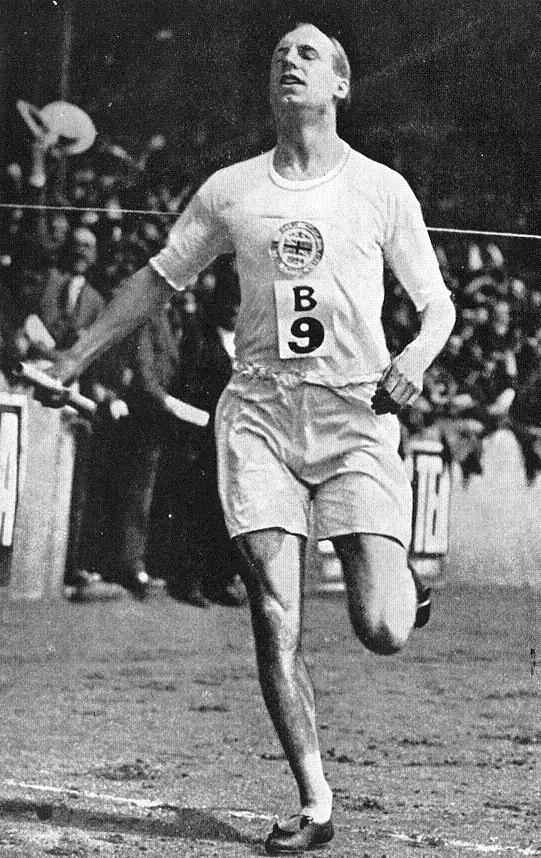
Subject: Eric Liddell (1902-1945) was an Olympic Gold Medalist (400m, 1924) and a missionary in Northern China, from 1925 until he was put into a Japanese internment camp, where he later died. He was famously (although somewhat sensationally) portrayed in the film Chariots of Fire, which won Best Picture for 1982.

Overview:

This story really starts where Chariots of Fire ends: with Liddell’s missionary call. Eric Liddell not only overcame obstacles at the 1924 Olympics; he served the people of China dauntlessly in the 1930s and on into World War II, giving up any shot at an Olympic return. He served for two decades in a rural and poor area of Hebei Province, in northern China, and stayed there even after the United Kingdom advised its citizens to leave in 1941. Somewhat over against the strong sacred-secular divide that may result from misinterpreting the 1982 film, Liddell did also compete in athletics during his missionary service, but he only did so in East Asia, and in ways that did not interfere with his other duties.

Eventually, after several close calls, Liddell was placed in an internment camp in 1943, on a school compound, and he spent the last two years of his life there. He died suddenly of a brain tumor in 1945, at the age of 43, but with much more to show for his life than any gold medal could offer: many lives changed for God. He took the same physical determination and sense of duty to the mission field, and bore it without complaint, cheerful yet self-effacing, devout but without pretense.

Meat:

I was impressed, as I read this book, that Liddell’s physical prowess served him well in the mission field. He was in rural China, without much access to modern transportation methods. Ramsey tells several anecdotes which show what an asset his physical endurance was in serving the poor on the mission field. I remember in particular that Liddell had to carry an injured man by wheelbarrow for many miles.

There were two athletic anecdotes in this book that literally made my jaw drop:

The first occurs in the film Chariots of Fire. During a race (I believe it was only 400m, but I am not able to verify), Liddell was knocked to the ground. Not only did he get back up and keep running, he won the race. (Movie clip here.)

The second is not mentioned in the film because it occurs after Liddell left for the mission field. Liddell did not give up running forever when he left Scotland—in fact, he competed in the Asian Games in Japan while he was living in China. However, he had a steamer to catch so that he could teach Sunday school the next day. Having placed at the games, he stood and saluted while they played through British national anthem, and then the French national anthem. Finally, he said his goodbyes and ran out of the stadium. Arriving at the pier, the ferry had just cast off. Not willing to be stuck in Japan two more days, Liddell reared back, got a running start, and jumped onto the ship as it was departing the pier.

Bones:

God’s Joyful Runner is a great introduction to Eric Liddell’s life and has much more than can be summarized in a brief article like this. But there are some aspects of Liddell’s life that it doesn’t tell us much about. It doesn’t say much, for instance, about Liddell’s writings. If readers want greater detail, though, I believe they could find that in David McCasland’s longer book, Eric Liddell: Pure Gold.

Review: Shadow of the Almighty

Rating:

Who: Elisabeth Elliot first became famous as the wife of Jim Elliot, missionary who was killed in Ecuador in 1956. After publishing the bestselling story of “Operation Auca” in 1957 (Through Gates of Splendor) and Jim’s story in 1958 (Shadow of the Almighty), she returned to the Huaorani with Rachel Saint to serve as a missionary until 1963, and became a respected devotional author in her own right.

Overview: Shadow of the Almighty is “the life and testimony of Jim Elliot,” one of five men who were killed in the Ecuadorian interior while trying to make contact with an unknown tribe, then known as the Aucas, now known by their endonym, Huaorani (also spelled Waodani).

Elisabeth Elliot had already shared the thrilling story of Operation Auca in her other bestselling book, Through Gates of Splendor, so this book acts as a prequel in some respects. Chronologically, this book ends where Through Gates of Splendor begins.

Meat: Shadow of the Almighty is essentially a journal of missionary consecration. That is the one secret of its impact. Numerous people first encountered the truth of the missionary call through Elliot’s books. The Elliots may come off to some people as traditional or perhaps stodgy, but no one can doubt this: their story has become a living link between the crucifixion and the Great Commission.

Almost the entire narrative happens in the United States, which emphasizes Elisabeth Elliot’s firm stance on missionary preparation. The story weaves together Jim’s early life, his consecration to ministry, his college days, and rather distanced courtship with Elisabeth. Only in the last few chapters is he on the mission field.

The Elliots’ strong roots in the Holiness movement give them a very countercultural stance, which must increase the notoriety of their books. Shadow of the Almighty‘s popularity has now continued unabated for more than half a century. At the time of this review, Elisabeth Elliot has three books in Amazon’s top 50 books on “Christian Missions & Missionary Work,” which is more than any other author.

Although this book, like many others, could stand to be salted with the grace of tolerating other viewpoints, the Elliots’ no-nonsense speaking style is tempered by plenty of humorous stories and interesting anecdotes both in America and in Ecuador.

Bones: Jim Elliot’s journals, which make up a large percentage of the book, are often a very private space in which he vents his disappointments and criticisms about himself and about the church. At some points, I felt that Elisabeth could have spared us so much detail, or at least so many criticisms of the modern church, which fall short of providing for her a better way.

One case in point is the story of their courtship and marriage, which was very protracted. Elisabeth has made much of their story not only in this book but in several others (Passion and Purity, Quest for Love). She shares Jim’s very negative opinions on marriage ceremonies as a cultural institution, an opinion likely stemming from their background in the Brethren, a nonconformist group with tame anti-establishment leanings. Jim was also flabbergasted when a colleague decided to marry ahead of joining the mission field—not sharing his joy or surprised merely, but actively disappointed. Elisabeth and Jim seemed to see Christian marriage first and foremost as a hindrance to missions, and have presented it that way to many young people.

Quotes:

“Missionaries are very human folks, just doing what they are asked. Simply a bunch of nobodies trying to exalt Somebody.” (p. 46)

“He is no fool who gives what he cannot keep to gain what he cannot lose.” (p. 108)

“The command is plain: you go into the whole world and announce the good news. It cannot be dispensationalized, typicalized, rationalized. It stands a clear command, possible of realization because of the Commander’s following promise. . . . Rest in this—it is His business to lead, command, impel, send, call, or whatever you want to call it. It is your business to obey, follow, move, respond, or what have you.” (p. 150)

“In my own experience, I have found that the most extravagant dreams of boyhood have not surpassed the great experience of being in the Will of God, and I believe that nothing could be better. . . . That is not to say that I do not want other things, and other ways of living, and other places to see, but in my right mind I know that my hopes and plans for myself could not be any better than He has arranged and fulfilled them.”