Ships of Pearl: The Signature Edition

This is the first update regarding our first crowdfunded book project, Ships of Pearl by F. W. Boreham. If you haven’t yet, head to the Kickstarter page to see how you can get a copy of F. W. Boreham’s rarest book.


Why F. W. Boreham?

F. W. Boreham has been endorsed by Charles Spurgeon, Billy Graham and Ravi Zacharias, but his classic books have fallen out of print, and some of them are impossible to obtain.

Why Ships of Pearl?

Ships of Pearl is not only extremely rare, but it is undoubtedly one of Boreham’s best works. Like The Passing of John Broadbanks, it came at a time when Boreham believed he was nearing the end of his writing career; his work had been perfected, polished, and seasoned with the salt of age.

At the moment, Ships of Pearl is F. W. Boreham’s rarest book—rarer than The Whisper of God or The Blue Flame, which Pioneer Library has already put back into print. Ships of Pearl is not currently in print, and you won’t see it for under $100 on Amazon, Abebooks, eBay, B&N, Alibris—you name it. At time of publication, the only copy for sale online costs $851.90 plus shipping. I believe that this is because someone using tailored software bought the last few copies on the Internet, and is waiting for someone foolish and desperate to make them a cool grand.

What will it look like?

We have prepared a new edition of this classic book, completely re-typeset to match as closely as possible the flavor of the original. We’ve also added 126 footnotes giving Scripture references, sources for quotations, and, occasionally, notes on the author’s dialect.

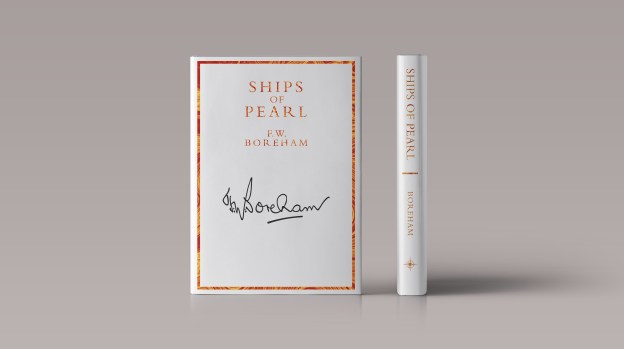
The new edition will be printed on 60-weight natural paper, which is opaque and easy on the eyes. The hardcover will have a cranberry linen cover with a custom gold foil stamp of the title and the author’s signature, as well as a tough 100-weight dust jacket.

Why Gorham?

We have gone with Gorham Printing, a short-run printer in Centralia, Washington. (Yes, we know! Boreham and Gorham!) Using a short-run printer means that we have to choose how many copies to order up front. Since out-of-print books are often forgotten to start with, we could not justify investing thousands of dollars without first knowing how many serious Boreham fans are out there.

All the books we have printed thus far have been softcover books, perfect-bound, and print-on-demand. This is a great option for affordability; however, the quality of the binding does not compare with that of a book from a print run. This means they don’t last as long. There is also no customizability with the big, outsourced print operations. Gorham allows us a litany of design options, and when we email them a question, we get a response from a human being, usually within a day.

Why Kickstarter?

We decided that Kickstarter was the best way to fund this project for two reasons: First, it is currently the most popular way to crowdsource funding for a business venture. Second, Kickstarter provides accountability. If the project doesn’t make, Kickstarter returns all pledges. And if a project doesn’t follow their guidelines, they can hold the designer responsible.

The thirty-day timeline is also important. We don’t have any warehouse or office space to deal with continual sales. Kickstarter enables us to have a short, focused period to sell these books, and then get back to our day jobs.

What about Amazon?

As much as it is humanly possible at this time, we are breaking up with Amazon. There are basically two reasons for this.

The first reason is erratic management. Because of its size, there is no redress for problems with the Amazon process. I have had multiple F. W. Boreham projects rejected by Amazon for unfounded reasons, but there is no appeal process to get my new books in print. In August 2017, they accepted The Drums of Dawn for Kindle publication, but rejected it for print publication. They did something similar for The Ivory Spires and When the Swans Fly High,. This effectively halted our new Boreham publications, and I have never received any explanation.

The second reason is justice. Amazon has been roundly criticized for employee abuse and monopolizing practices. When ebooks hit the global market, Amazon took a seven-figure hit in its prices, just so that they could crush their only viable competitor, Barnes and Noble. They also bought out their only online competitor, Abebooks. Brick-and-mortar bookstores throughout North America are closing their doors because of Amazon’s ruthless business practices.

How do I get on board?

Go to our Kickstarter page to see how you can contribute to making this book a reality. If our project succeeds, you will get a brand new, hardback copy of Ships of Pearl for only $40, and you can order both print and digital for $50.

Introducing the New Ships of Pearl

Our design team has put together a new, hardback edition of F. W. Boreham’s rarest book, Ships of Pearl. You can pre-order a copy for $40, or get both print and digital for $50, over at the Kickstarter page.

The book is not available anywhere else, and this offer will only last until April 1. Jump on board if you want to see Ships of Pearl back in print!

Review: Oswald Chambers: Abandoned to God

Rating: ★★★★★

Author: David McCasland is an American educator whose books include Blind Courage, co-authored with Bill Irwin, the first blind person to thru-hike the 2,162 mile Appalachian Trail; Oswald Chambers: Abandoned to God; and Eric Liddell: Pure Gold. David writes for Our Daily Bread and also develops biographical television documentaries as a writer and co-producer for Day of Discovery.

Subject: Oswald Chambers was a teacher of the Bible in the United Kingdom, a chaplain to World War I soldiers in Egypt, and author of numerous devotional books, mostly compiled posthumously by his indefatigable wife, Biddy. Chambers’ intense and thought-provoking style has made his book My Utmost for His Highest (again, Biddy’s compilation) the best-selling devotional book of the 20th century.

Overview:

In the introduction, McCasland skillfully portrays the feeling of incompleteness that haunted “Biddy” Chambers after her husband died, seemingly needlessly, at the age of 43. She could not have known that through her work, her husband would be become the best-selling devotional author of the century.

Chambers’ life has much more of adventure to it than one might expect. Knowing something of Chambers’ inimitable writing, I half-suspected him to be a brooding Scotsman, dreary and intense. But McCasland ably portrays Chambers as tall, open-faced, and lithe, someone who loves children, games, and even pranks. In his younger days, he trained to be an artist. He also travelled widely in later years, doing preaching and teaching tours with ministry partners in the United States (mainly Cincinnati) and in Japan.

His early ministry (in his late twenties and early thirties) involves well-known Christians across a broad theological spectrum. He heard Alexander Whyte preach in Edinburgh; Reader Harris (Pentecostal League of Prayer) had a great influence on him in his early years; G. Campbell Morgan spoke at the first anniversary of his school; and he worked with Charles and Lettie Cowman in Japan. He took an interestingly moderate position when the “tongues” movement hit England, neither despising them nor imposing them as a necessity.

From 1911 to 1915, Chambers was the founding principal of the Bible Training College in London. They had 106 students during that time, and at the end of the period, 40 of them were serving as missionaries. Chambers was also extremely productive. During this short period, the sermons, lectures, and notes that he produced comprised a formidable body of work, including the bulk of the following books: Biblical Ethics, Biblical Psychology, Bringing Sons unto Glory, He Shall Glorify Me (lectures on the Holy Spirit), Not Knowing Whither (from the Old Testament Studies class), Our Portrait in Genesis (also from the OT class), The Psychology of Redemption, and So Send I You.

Chambers did not work from a writer’s cabin. He sowed in faithfulness for many years as a Bible teacher in Scotland and England. He taught Bible concepts faithfully but was very innovative in the way he presented them, using alliterative headings, terse explanations, and modern metaphors.

In 1915, the work of the school was suspended because of World War I, and Chambers went to Egypt to serve as a YMCA chaplain to soldiers. During this time he continued his labor of love, writing, preaching, and teaching evening classes to soldiers. The materials produced during this time became the books Baffled to Fight Better (on Job), The Shadow of an Agony (on redemption), and Shade of His Hand (on Ecclesiastes).

Chambers died of appendicitis in 1917, at the age of 43. What must have made it more difficult for his family was that he could have availed himself of better medical assistance, but he did not want to take a hospital bed from a wounded soldier.

Meat:

One of the key insights of this book is the unforgettable role that Biddy Chambers had in bringing her husband’s works to light. Oswald Chambers himself did, as far as we can tell, very little actual writing during his lifetime, and nearly all of his published works are arranged from various talks, lectures, and sermons, mostly from the years between 1911 and 1917. Christians owe a great debt to this woman who turned the bitter years of widowhood into a sweet ministry that has blessed the globe.

Bones:

This is one of the best biographies I have ever read, and should be ranked with God’s Smuggler and Bruchko though with not quite so much intrigue or scandal to attract sleepy readers. I find very little fault in it, though it is quite long. The story is a bit slow near the beginning when Chambers has not really embarked on his life’s work yet, but otherwise the book flows from episode to episode, and paints as personal a picture as could possibly be drawn more than 70 years after Chambers’ death.

McCasland is a masterful biographer, and my chief regret in reading this was to find out that he has published so few biographies: only this and two others.

Free Book for Lent: Shadows of the Cross (Birks)

I recently made a trip to the British Library at St. Pancras, London, and digitized quite a few scarce English books by my personal favorites like F. W. Boreham and H. A. Birks (author of Jesus, a Man of Sorrows; The Life of Thomas Valpy French; and numerous other works). Birks was a scholar and preacher who published several books intended especially for use during Lent:

  • Jesus, a Man of Sorrows (now available for Kindle)
  • God’s Champion, Man’s Example (forthcoming)
  • The Shadow of the Cross in Our Lord’s Ministry

For the occasion of Lent 2020, I wanted to make this third book publicly available, so I have uploaded at the link below.

Unless you have library access in Cambridge, Dublin, Edinburgh, Cardiff, or the British Library in London, you will probably never see a physical copy of this book. It has been out of print since 1892—for 128 years.

The Shadow of the Cross in Our Lord’s Ministry – free PDF download (17.1 MB)

If you are looking for a 40-day daily devotional created just for Lent, you can also check out In the Desert with Jesus.

Review: God’s Joyful Runner

Rating: ★★★★★

Author: Russell Wilcox Ramsey is an American athlete, writer, and a national security educator. He was decorated with the Bronze Star and is a National Record Holder in swimming (men, 55-59 age group). In addition to many books on national security, he has written several books related to Christian athletes and the Olympics, including God’s Joyful Runner: The Story of Eric Liddell (1987), the novel A Lady, A Peacemaker (1988), and the Christian living book From Mount Olympus to Calvary (2014).

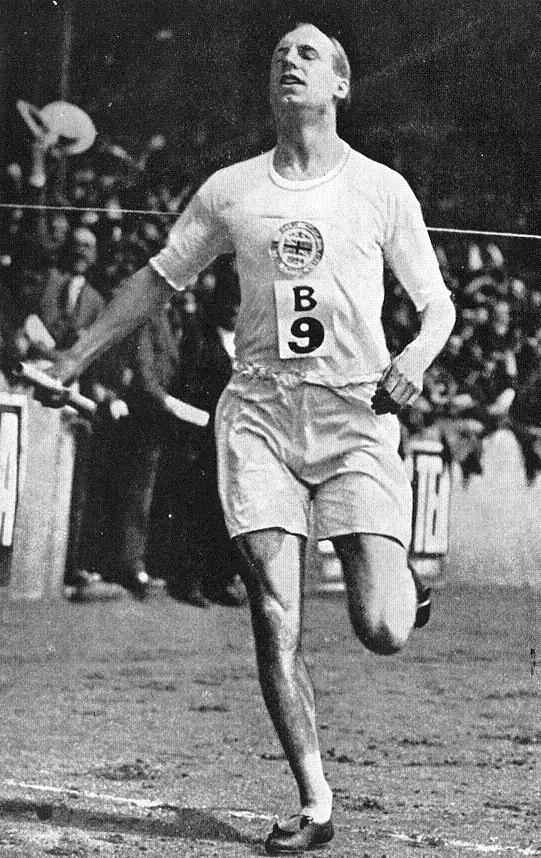
Subject: Eric Liddell (1902-1945) was an Olympic Gold Medalist (400m, 1924) and a missionary in Northern China, from 1925 until he was put into a Japanese internment camp, where he later died. He was famously (although somewhat sensationally) portrayed in the film Chariots of Fire, which won Best Picture for 1982.

Overview:

This story really starts where Chariots of Fire ends: with Liddell’s missionary call. Eric Liddell not only overcame obstacles at the 1924 Olympics; he served the people of China dauntlessly in the 1930s and on into World War II, giving up any shot at an Olympic return. He served for two decades in a rural and poor area of Hebei Province, in northern China, and stayed there even after the United Kingdom advised its citizens to leave in 1941. Somewhat over against the strong sacred-secular divide that may result from misinterpreting the 1982 film, Liddell did also compete in athletics during his missionary service, but he only did so in East Asia, and in ways that did not interfere with his other duties.

Eventually, after several close calls, Liddell was placed in an internment camp in 1943, on a school compound, and he spent the last two years of his life there. He died suddenly of a brain tumor in 1945, at the age of 43, but with much more to show for his life than any gold medal could offer: many lives changed for God. He took the same physical determination and sense of duty to the mission field, and bore it without complaint, cheerful yet self-effacing, devout but without pretense.

Meat:

I was impressed, as I read this book, that Liddell’s physical prowess served him well in the mission field. He was in rural China, without much access to modern transportation methods. Ramsey tells several anecdotes which show what an asset his physical endurance was in serving the poor on the mission field. I remember in particular that Liddell had to carry an injured man by wheelbarrow for many miles.

There were two athletic anecdotes in this book that literally made my jaw drop:

The first occurs in the film Chariots of Fire. During a race (I believe it was only 400m, but I am not able to verify), Liddell was knocked to the ground. Not only did he get back up and keep running, he won the race. (Movie clip here.)

The second is not mentioned in the film because it occurs after Liddell left for the mission field. Liddell did not give up running forever when he left Scotland—in fact, he competed in the Asian Games in Japan while he was living in China. However, he had a steamer to catch so that he could teach Sunday school the next day. Having placed at the games, he stood and saluted while they played through British national anthem, and then the French national anthem. Finally, he said his goodbyes and ran out of the stadium. Arriving at the pier, the ferry had just cast off. Not willing to be stuck in Japan two more days, Liddell reared back, got a running start, and jumped onto the ship as it was departing the pier.

Bones:

God’s Joyful Runner is a great introduction to Eric Liddell’s life and has much more than can be summarized in a brief article like this. But there are some aspects of Liddell’s life that it doesn’t tell us much about. It doesn’t say much, for instance, about Liddell’s writings. If readers want greater detail, though, I believe they could find that in David McCasland’s longer book, Eric Liddell: Pure Gold.

Review: Hosea: The Heart and Holiness of God

Rating: ★★★★★

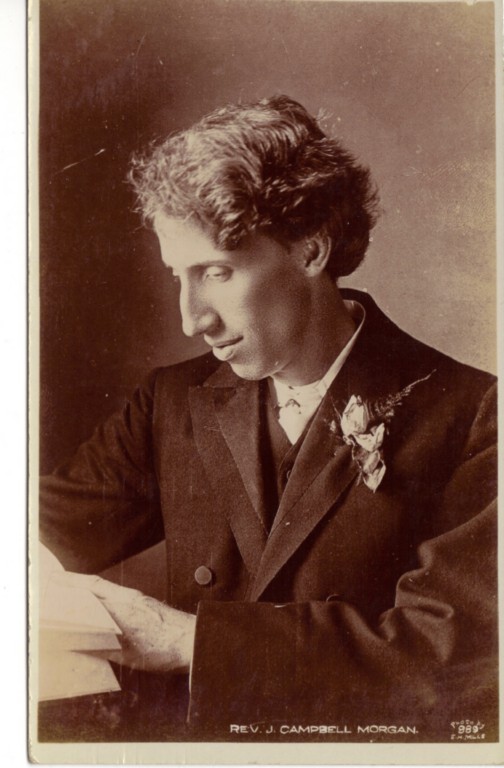
Author: G. Campbell Morgan was a British Congregational preacher, active from 1883 to 1943, mostly at Westminster Chapel in London. Nicknamed “the Prince of Expositors,” Morgan’s accessible expository preaching gained him a wide audience on both sides of the Atlantic. During his long life of ministry, he published more than 60 books, many of which were sermons.

Overview:

Hosea: The Heart and Holiness of God (1934) is a masterful exposition of the prophecy of Hosea. Morgan’s style of exposition is not verse-by-verse, but rather utilizes thematic verses that summarize the key points of a chapter.

As implied in the title, his summary of Hosea is that it is about the union of God’s compassion and his holiness. G. Campbell Morgan is able to paint such a beautiful picture of God because he learns the brushstrokes from the Bible itself. In this book he will stretch your heart and stretch your theology as you see the suffering heart of God, longing to see his redeemed people walking in holiness, walking with him. But as always he exposits the Word with reverence and simplicity.

The first couple of sermons deal with Hosea’s suffering as prophet. There are many in the middle dealing with the defection of the people and its causes and course. The last few sermons were in my opinion the best as he talks about the love of God for his people, how he cannot give them up to a life without Him, but sent His missionary Son to pursue His straying lover, His prodigal son—His people.

Meat:

Morgan’s sermons are almost always simple, readable, applicable, and committed to the biblical text.

In much of his exposition, Morgan dwells long on the themes of God’s grief in Hosea, a prominent topic that is often shied away from because of its doctrinal difficulties. See for instance, the chapter entitled “The Difficulty of God”, on Hosea 6:4; while such language entangles systematic theologians in a thicket of complications, Morgan resolutely and simply discusses its meaning as it stands. He also does so without making God sound spineless or desperate. It illustrates Morgan’s commitment to the text, and vindicates him as an important preacher and writer for those interested in doing practical, biblical theology (as opposed to “systematics”).

Bones:

Morgan’s strength is how he deals with the text, but if he has a weakness, it would be in spiritualizing what were meant to be historical events in the text.

Review: The Crimes of England

Rating: ★½

Author: G. K. Chesterton was a devoutly Catholic journalist, poet and novelist of the early 20th century. His most apt nickname is “The Prince of Paradox.”

Genre: Non-fiction, wartime essays.

Overview:

After the publications of The Barbarism of Berlin and its expanded edition, The Appetite of Tyranny, Chesterton wrote this longer work (published in January 1916) in defense of the same ideas. Ostensibly, the book is a confessional of England’s “crimes” in recent history, meaning the late nineteenth century:

I have thought it advisable to provide you with a catalogue of the real crimes of England. (p. 9)

In reality, though, the title is an ironic jab against England’s then-recent policy of having Germany as an ally. He means to recount how badly Germany has treated England and Europe, and England’s “crime” of being all too forbearing with Germany.

Long and weary as may be the records of our [England’s] wickedness, in one direction we have done nothing but good. Whoever we may have wronged, we have never wronged Germany. (p. 53)

Chesterton held to what some reviewers have called “Teutonophobia,” and his account of England’s so-called crimes amounts mainly to not throwing Prussia under the bus when they had a chance.

For all readers except those most keenly fascinated by European history and politics, this book will make undoubtedly dull reading, set as it is in a balance of power that is no longer relevant, and dealing with the emotions of a war that not even centegenarians would recall directly.

Meat:

This book has one minor advantage over Appetite of Tyranny in that his anger over the outbreak of World War I had had another year to mellow, and he tries to substantiate his position historically, rather than through cultural generalizations.

Modern reviewers may be interested in Chesterton’s occasional reference to German race theory, called by him “Teutonism”—as well as the related idea which he calls “pan-Germanism,” that every great genius must have been Prussian. Chesterton calls this Germany ideology “a religion”:

Not a race, but rather a religion, the thing [Teutonism] exists; and in 1870 its sun was at noon. (p. 49)

Here he was referring back to the Franco-Prussian War, in which Germany achieved its unification and changed the balance of power in Europe. Chesterton didn’t know, of course, that pro-Aryan ideology would lead to another world war and millions more deaths just 23 years later.

As an aside, Chesterton takes the pro-Irish side on “the Irish question” in this book, a stance solidified soon after in his 1919 book Irish Impressions and also mentioned in What I Saw in America (1922).

Bones:

The Crimes of England mainly suffers from the same defects as The Appetite of Tyranny, so I refer my readers to that review.

I add to those criticisms as well that it was a deplorably dull read. Chesterton handles most topics well, but neat chronological accounts were not his forte, and so his account of historical relations between England and Germany is barely readable to someone who is not deeply acquainted with the time period.

Quotes:

These below are given to exemplify the author’s opinions in this book, not those of the reviewer:

I have passed the great part of my life in criticising and condemning the existing rulers and institutions of my country: I think it is infinitely the most patriotic thing that a man can do. . . . I think our whole history in Ireland has been a vulgar and ignorant hatred of the crucifix, expressed by a crucifixion. I think the South African War was a dirty work which we did under the whips of moneylenders. I think Mitchelstown was a disgrace; I think Denshawi was a devilry. (p. 53)

The German superiority has been in a certain thing and of a certain kind. It is not unity; it is not, in the moral sense, discipline. Nothing can be more united in a moral sense than a French, British, or Russian regiment. Nothing, for that matter, could be more united than a Highland clan at Killiecrankie or a rush of religious fanatics in the Soudan. What such engines, in such size and multiplicity, really meant was this: they meant a type of life naturally intolerable to happier and more healthy-minded men, conducted on a larger scale and consuming larger populations than had ever been known before. (p. 61)

Free Books by G. Campbell Morgan (50+)

Some readers may remember that, about ten years ago, a number of G. Campbell Morgan books (which are in the public domain) were freely available online at gcampbellmorgan.com (then the G. Campbell Morgan Archive). These were nice because they were already formatted, and the PDFs were proofreaded and readable.

With the advent of ebooks, this was turned into a paysite, and has apparently been shut down or changed domains.

However, you can still access the old free website thanks to archive.org’s Wayback Machine, which is a web crawler that archives websites.

Use the links below:

Free G. Campbell Morgan books on the Internet Archive (50+)
Free G. Campbell Morgan audiobooks on LibriVox (3)
Free G. Campbell Morgan books on the Wayback Machine (30+)

Review: Magic (GKC)

Rating: ★★★★

Author: G. K. Chesterton was a devoutly Catholic journalist, poet and novelist of the early 20th century. His most apt nickname is “The Prince of Paradox.”

Full title: Magic: A Fantastic Comedy.

Genre: Play, comedy.

Overview:

This play is set at the Duke’s home. The action begins with the search for his adult niece, Patricia Carleon, who has been in the garden, exploring Fairyland.

[Enter Patricia.]
Carleon. [Still agitated.] Patricia, where have you been?
Patricia. [Rather wearily.] Oh! in Fairyland.
Doctor. [Genially.] And whereabouts is that?
Patricia. It’s rather different from other places. It’s either nowhere or it’s wherever you are.

Thus Patricia, the mystic, sparks a debate about belief involving herself, her uncle, and her uncle’s guests. The themes about disbelief and skepticism in this little play are strongly echoed in C. S. Lewis’ The Lion, the Witch, and the Wardrobe, which in 1950 became the first of The Chronicles of Narnia series. An interesting difference is that Lucy, who discovers Narnia, is a child; while Patricia, in Chesterton’s play, is an adult. Chesterton wants the reader to know that belief is not confined to childhood or naivete.

Conjurer. [Contemptuously.] Yes, your Grace, one of those larger laws you were telling us about. (p. 42)

Published in 1913 and performed in London’s Little Theatre, this is the first of only three plays written by Chesterton and performed during his lifetime. (A fourth was published posthumously.) This is also the only one of his plays that is widely accessible today, having been digitized by Project Gutenberg.

Meat:

The debate about belief is resolved in much the same way as it is in The Lion, the Witch, and the Wardrobe: we are reminded of the gloriously child-like wisdom of giving people the benefit of a doubt when they speak of miracles.

Why should sham miracles prove to us that real Saints and Prophets never lived. There may be sham magic and real magic also. . . . There may be turnip ghosts precisely because there are real ghosts. There may be theatrical fairies precisely because there are real fairies. You do not abolish the Bank of England by pointing to a forged bank-note. (p. 30)

One character notes that disbelief is just as bad a curse as gullibility.

Here is the boy who questions everything and a girl who can believe anything. Upon which has the curse fallen?

Bones:

There is not a lot of action in this play. The plot would have been more memorable if it had been a little longer or had more change of scenery.

Quotes:

Old women have taught you that the fairies are too small to be seen. But I tell you the fairies are too mighty to be seen. (p. 4)

The Doctor does not believe me. He is an agnostic; and he knows everything. (p. 43)

There is no bigot like the atheist. (p. 47)

Read: LibriVox (audiobook), Internet Archive (pdf), Project Gutenberg (epub/mobi/html), Kindle Store (mobi)

St. George of England

Mine eyes were sealed with slumber; I sat too long at the ale.
The green dew blights the banner; the red rust eats the mail.
And a spider spanned the chasm from the hand to the fallen sword,
And the sea sang me to sleep; for it called me lord.

This was the hand of the hero; it strangled the dragon’s scream,
But I dreamed so long of the dragon that the dragon was a dream:
And the knight that defied the dragon deserted the princess.
Her knight has stolen her dowry; she has no redress.

Mirror of Justice, shine on us; blaze though the broad sky break
Show us our face though it shatter us; shatter and shake us awake!
We were not tortured of demons, with Berber and Scot,
We that have loved have failed thee! Oh, fail us not!


Source: G. K. Chesterton, The Queen of Seven Swords. London: Sheed & Ward, 1926, p. 49.