Author Archives: A.A.

Unknown's avatar

About A.A.

Go where no one else will go. Do what no one else will do.

Review: The Psalms of David Imitated

Rating: ★★★

Full Title: The Psalms of David: Imitated in the Language of the New Testament, and Apply’d to the Christian State and Worship

Author: Isaac Watts (1674-1748) is known as the father of English hymnody. He is the author of an remarkable quantity of Christian hymns, probably only surpassed by the Wesley brothers and Fanny Crosby. His most famous hymns are “Joy to the world” (found here in his Psalms of David) and “When I survey the wondrous cross” (found in his Horæ Lyricæ). He was also renowned as a logician and coined the “straw man” fallacy.

Overview:

Watts’ Psalms of David Imitated (1719) was a watershed book in English Protestantism. Psalms of David Imitated were part of a long tradition of singing paraphrased psalms, which began in the Protestant era with the Genevan Psalter (1539) and the Scottish Psalter (1564); but Watts also wrote and encouraged the use of (non-Scripture-based hymns in his other works, namely Horæ Lyricæ. Thus, Watts, in a sense, bridges the divide between two traditions of Protestant worship: exclusive psalmody and hymns. This will require some background.

Historically, hymns have been used in Christian worship since its earliest era. But the Protestant Reformation led to a split in practice between certain churches (German; English), which sang hymns, and other churches (Geneva; Scotland), which practiced exclusive psalmody and believed that practices not expressly authorized in the Bible were forbidden (i.e., as vestiges of Catholicism). Martin Luther, of course, did not follow this latter principle and wrote many hymns himself. Because of his work, a revolution in German church music happened in the early 16th century; the accompanying revolution in English church did not happen for 200 years. Writers such as Benjamin Keach (1640-1704), Isaac Watts (1674-1748), and Benjamin Beddome (1717-1795) promoted the principles of freedom in worship in Protestant churches; but Watts’ prolific verse in particular became known as a mark of this transition.

I have not read straight through other psalters, but, as far as I can tell, Watts does not follow the psalms as strictly as other paraphrased psalters. As suggested in the subtitle, he brings in as much as he can of New Testament theology, mentioning in turn the birth of Christ, his work of atonement, and his second advent.

I was very excited that I managed to dig up an early edition of this book in a digital format, which included such classics as “Joy to the World” as they were printed by the author himself. I can say, though, that “Joy to the world” is easily the best the volume had to offer. The name of the game here is quantity, not quality.

Meat:

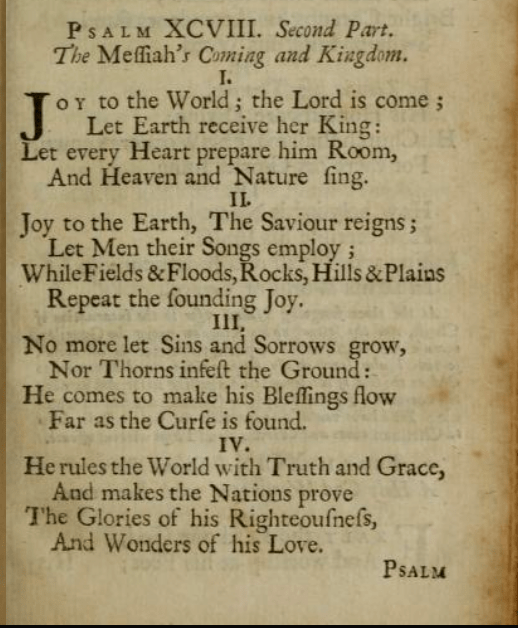
Everything glorious about this book is epitomized in its most famous paraphrase, given in the book as “Psalm 98, Second Part” and subtitled “The Messiah’s Coming and Kingdom,” but known today by its first line:

Joy to the World; the Lord is come!
Let earth receive her King;
Let every heart prepare Him room,
And Heaven and nature sing.

Joy to the earth, the Savior reigns!
Let men their songs employ;
While fields & floods, rocks, hills & plains
Repeat the sounding joy.

No more let sins and sorrows grow,
Nor thorns infest the ground;
He comes to make his blessings flow
Far as the curse is found.

He rules the world with truth and grace,
And makes the nations prove
The glories of His righteousness,
And wonders of His love.

If we can get past the commonality of these words, we will realize Watts’ vision of the overawing supremacy of God our Creator, and the power of his atonement. Here The Psalms of David Imitated is at its strongest.

Bones:

People often praise the depth of Watts’ theology, but in this work I primarily sense the sternly judicial aspects of God’s love and care. Watts ties everything to God’s majesty and sovereignty, if anything, much more so than the psalms themselves. The tone is strictly Calvinist. For a more relational theology that draws deeply from the cross, I would highly recommend his other works. But if you want to a vision of God’s glorious sovereignty, The Psalms of David Imitated is well nigh unbeatable.

There are two other related hymnbooks that are too long to receive their own reviews, but which I recommend here as alternatives:

Watts’ Horæ Lyricæ, is less cramped in its form and content by the constraints that the psalms put on Watts. In his Psalms of David, Watts also constrains himself in terms of meter, to make these verses better for congregational singing.

Samuel Worcester has a well-done edited compilation (1859) that draws from all of Watts’ works, and I believe that it gives the best sampling. Watts is very prolific and reading these in the original was much less inspiring than Cowper’s Olney Hymns, for example, because of its length and lack of variety.

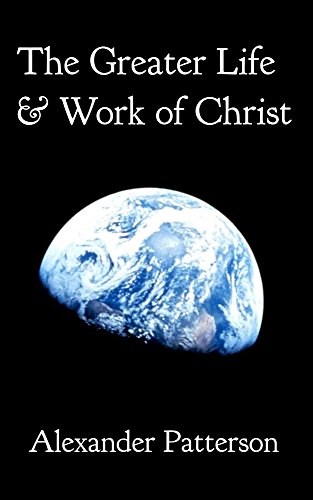
Review: The Greater Life and Work of Christ

Rating: ★★★★★

Author: In addition to The Greater Life and Work of Christ, Alexander Patterson is the author of The Other Side of Evolution: Its Effect and Fallacy (1903), and Broader Bible Study.

Overview:

The Greater Life and Work of Christ (1896) is a novel take on a genre known well in Patterson’s day: “the life of Christ.” Many famous theologians published attempts at biographies of Jesus in the second half of the nineteenth century, most of them titled simply The Life of Christ. The focus of this genre was to present a kind of narrative gospel harmony, and sometimes a more introspective, speculative, or biographical look at how Jesus interacted with people and went about his day. Some popular and typical examples include that of Dawson (1874), F. W. Farrar (1875), James Stalker (1880), Joseph Parker’s Inner Life of Christ (1883), and Edersheim’s Life and Times of Jesus the Messiah (1883). Some more modern examples include R. J. Campbell’s Life of Christ (1921) and Fulton Oursler’s The Greatest Story Ever Told (1948).

Patterson’s book differs significantly from all of the above. In the preface to his book, he states his theme:

It will be seen at a glance that this is not a life of Christ in the usual sense. It is not a review of the events of the earthly existence of our Lord. There is a greater life and a larger work of Christ of which his life on earth is but a single chapter. . . . The great defect in the study of Christ is to consider him in but a single chapter of his life and work.

Thus, literally, “Christ in His Earthly Life” is only one of Patterson’s seven chapters. The table of contents is worth a long look:

I. Christ in the Eternal Past
II. The Word: Christ in Creation
III. Jehovah: Christ in the Old Testament Age
IV. Jesus: Christ in His Earthly Life
V. Jesus Christ: Christ in His Present State and Work
VI. The King of Kings and Lord of Lords: Christ in the Day of the Lord
VII. Christ in the Eternal Future

Chapter IV has its source texts mainly in the Gospels; chapter VI and VII have their source texts mainly in the Revelation. The other chapters, though, are fascinating composites of thoughts drawn from a variety of Scriptures. When you read about “Christ in Creation” you will marvel at how many Scriptures speak of Jesus at Creation, and wonder why you have so seldom heard a sermon on such a worthy topic. I also enjoyed the meditations on “Christ in His Present State and Work”—the comfort of the intercession of Christ for us was a topic constantly on the lips of the Puritans, but it is a topic seldom explored at any length today.

Patterson is rather ahead of his time on some topics. He takes a bird’s-eye view of Scripture that is attractive for its thoroughness. The first three chapters are often in innovative territory as he draws together Scriptures in new ways. Interestingly, he was an early opponent of evolution, and there is one section of “post-colonial” thoughts that sounds like it was in yesterday’s Christiantiy Today, even though he lived at the height of the British Empire.

Because it follows a chronological scheme, this book may seem at first like dispensational theology, but that is really outside its goal. Rather, Patterson’s purpose is to present the unity in Christ’s work throughout history, over against its disparities.

Meat:

The very idea of this book is thrilling in itself, beginning in eternity past and ending in eternity future. There is such a variety of thoughts and Scriptures that it is difficult to choose only a few quotations.

One high point of the book is that Patterson takes an essentially missional view of the Church.

The church exists for a specific work—the proclamation in all the world of the gospel of the cross of Jesus Christ as declared by himself and his apostles. This we dare not neglect for any other mission, however good.

Along these lines, in Chapter VI, he usefully differentiates Christians from Christendom—meaning the historically-Christian or majority-Christian nations of Europe and the North America. His comments here were remarkably ahead of their time, written in the 1890s, and I felt it was worth sharing the whole section:

What will be the record of Christendom? It has laid hands on the fairest regions of the world “for their good” and ostensibly to “extend civilization,” really to extend national power and trade and to enrich the merchants of the dominant nations. It has taken, without compensation, from weaker nations their God-given heritage . . . The work of the missionary of the gospel has been taken advantage of, and has been followed by the trader, and he by the soldier. There has followed them the train of evils which have destroyed these peoples. Opium was forced into China by Christendom. Rum is being poured into Africa by Christendom.

Where the so-called Christian civilization has appeared, the native races have gone down by its drugs, drinks, and diseases. It has put into the hands of these races, arms and material of most diabolically consummate perfection for the destruction of human life. It calls the arming of these peoples with these infernal weapons “advancing in progress and civilization.” It lends them money for this purpose and sends them teachers who instruct them in the satanic art of wholesale butchery of human life, and sets them at war with each other, and profits by their mutual destruction.

There has been given the nations of whole continents, in place of their original paganism, a bastard Christianity more difficult to overthrow than their pagan faith. . . . The God of heaven and earth is not oblivious to the awful sins of Christendom.
(p. 273-274, 2017 ed.)

Bones:

This book is very long but very good. The only part where I felt very bogged down was the eschatology. A reader cannot help but think that many of the thoughts presented are speculative. That being said, I highly recommend that you finish the book if you can, because the conclusion masterfully synthesized all that preceded and fully compensated for the less exciting sections.

Read: You can read this book for free on the Internet Archive, or you can listen to it free on LibriVox.

New Reprints from Louis Albert Banks

Pioneer Library recently put six books by Louis Albert Banks back into publication, in both print and digital platforms.

Louis Albert Banks is known for the creative illustrations that he used in his evangelistic sermons as well as his shorter talks (as in Unused Rainbows). His sermons are remarkable in both their quality and quantity.

Print (paperback):

  1. David and His Friends
  2. The Fisherman and His Friends
  3. John and His Friends
  4. The New Ten Commandments
  5. Paul and His Friends
  6. Unused Rainbows

Digital (Kindle Store):

  1. David and His Friends
  2. The Fisherman and His Friends
  3. John and His Friends
  4. The New Ten Commandments
  5. Paul and His Friends
  6. Unused Rainbows

Plans are in the works to put many more of his rare books back into print and to make them available in the Kindle Store. Follow us on our Facebook or WordPress page to get consistent updates!

Review: Letters from a Skeptic

Rating: ★★★

Author: Gregory (Greg) Boyd is an American pastor and theologian known for promoting relational theology. He is best known for popular theology books like Letters from a Skeptic and Myth of a Christian Nation, but he has also written ambitious theological works like God at War and The Crucifixion of the Warrior God.

Overview:

This book is an apologetics crash course, packaged as a correspondence between a theologian and his skeptic father. It is atypical in that the main problem dealt with in this book was theodicy and theology proper. About half of book deals with suffering and the freedom of God in his Creation.

Boyd’s response to these issues is found in the relational theology of open theism, which is a modification of Arminianism. As such, some of the answers are identical to those given by C. S. Lewis:

It is not the will of God which keeps sinners in hell, but the will of sinners. (p. 198)

Where did our longing for something that never existed, and that never could exist, come from? (p. 70)

Other concepts will sound quite novel for those unfamiliar with relational theology:

We tend to become the decisions we make. The more we choose something, the more we become that something. We are all in the process of solidifying our identities by the decisions we make. (p. 51, emphasis his)

I should add, here, that some online reviewers doubt the veracity of the letters because of the overall tone in writing being so similar; my gut feeling is that this could be the result of excessive editing, but I don’t see any reason to doubt the overall story.

Meat:

The strengths of the book include discussions of the problem of evil, free will, Satan, biblical prophecy, the problem of the existence of hell, and problems in the biblical canon. Whereas elsewhere Boyd gets into polemical discussions related to Calvinism and open theism, I liked that this book kept it more to discussing basic objections to faith and didn’t get too bogged down.

If you enjoy the relational theology of writers like George MacDonald, you will probably find the theology of this book compelling and interesting, though liberal on some points. If you hate Arminianism, this book is not for you.

Bones:

I would recommend this book with a few reservations:

1. Accessibility: It was written by a theologian, not your typical pastor. As such it contains a few brief discussions of some things which may not even be relevant: canonization, source criticism, etc. He tries to make it accessible, but a few of the sub-points here are pretty nitty-gritty.

2. Interpretation: Some would consider Greg to be pretty liberal in interpretation, and many Calvinists find him offensive for his free will theology in this book. However, as I stated, I think we get less of his snark in this book than some others!

3. Hell: Near the end both are overly sympathetic (in my opinion) with annihilationism, the belief that souls are destroyed in Hell rather than eternally tortured. This is mentioned only cursorily, and Greg says that he has “exegetical reservations” but nevertheless tells his dad that it is a “viable option.” His father practically accepts this hook-and-sinker with no further discussion.
I’m sure their discussion of this was not over in one letter, but I don’t like the impression that it gives in the book. Most of the book does a good job grappling with such questions, but this answer was pretty dismissive! What about Revelation 14:11?

And the smoke of their torment will rise for ever and ever. There will be no rest day or night for those who worship the beast and its image, or for anyone who receives the mark of its name.

I wouldn’t form theological opinions based on this book alone, but I think for anyone, it could help them to think through some of the most basic issues of the faith and suffering, along with outside discussion.

The Glory of the Impossible

This article by I. Lilias Trotter (then of Tunis) was first published in pamphlet form (no date) and reprinted in the Missionary Review of the World in August 1913, the version given here. Samuel M. Zwemer also referenced this article in his 1911 book, Unoccupied Mission Fields of Asia and Africa.


“You do not test the resources of God till you try the impossible.”—F. B. Meyer

“God loves with a great love the man whose heart is bursting with a passion for the impossible.”—William Booth

“We have a God Who delights in impossibilities.”—Andrew Murray

Far up in the Alpine hollows, year by year, God works one of His marvels. The snow-patches lie there, frozen into ice at their edges from the strife of sunny days and frosty nights; and through that ice-crust come, unscathed, flowers in full bloom.
Back in the days of the bygone summer, the little soldanella plant spread its leaves wide and flat on the ground to drink in the sun-rays, and it kept them stored in the root through the winter. Then spring came, and stirred its pulses even below the snow-shroud. And as it sprouted, warmth was given out in such a strange measure that it thawed a little dome in the snow above its head. Higher and higher it grew, and always above it rose the bell of air, till the flower bud formed safely within it; and at last the icy covering of the air-bell gave way, and let the blossom through into the sunshine, the crystalline texture of its mauve petals sparkling like the snow itself, as if it bore the traces of the flight through which it had come.

And the fragile thing rings an echo in our hearts that none of the jewel-like flowers nestled in the warm turf on the slopes below, could waken. We love to see the impossible accomplished. And so does God.

Gazing north, south, east, and west over His world, with the signs of coming spring in one nation after another, two great tracts catch our eye, still frost-bound, as it were, in snow and ice. Hitherto, in the main, they have held out against the gleams of His sunshine, that have come to them, and it looks as if it must be long before we shall see grass and flowers appear. They are the Caste Religions of India, and yet more unbroken in its resistance, the power of Islam throughout the world.

And the watchers there have a fight sometimes, lest the numbness and chill that reign around should creep into their own souls with the hope deferred; and the longer they stay, the more keenly they realize the dead weight, impenetrable, immovable, that shuts down like a tombstone the weak little germs of life that lie buried beneath it.

It may be you have, half unconsciously, avoided looking the situation square in the face, lest faith should be weakened. But faith that has to ignore facts is not real faith.
Think over steadily the position of one of these imprisoned souls as he comes in contact with God’s message. Try to understand the intense prejudice and conservatism, the absolute satisfaction with a creed that fits so well the religious instincts, and leaves him so free to sin. Then, if a stir begins in the rigidity of his mind and the torpor of his conscience, and he wakes out of the paralysis of fatalism, it is only to stumble up against a fresh barrier. His very heartstrings are involved in the matter. Think what it means for him, with his Eastern imagination and his Eastern timidity, to face the havoc that confession of Christ would involve—the dislocation of every social detail, the wrecking of home and prospects, and the breaking of the hearts of those he loves. Everything that has made life to him must go, and possibly life itself, if he moves toward the light.

Behind all this and beyond it, both in this case of Mohammedanism and Caste, is the strange, magnetic hold of the system over every fiber of the nature. It is so strong that even tiny children are under its spell—creatures that with us would be still in the nursery, take a pride and delight in their stern Caste regulations, and their share in the Ramadan fast. And behind that again, and probably the true explanation of the fascination, lies the purpose of the devil, that these his two entrenched positions, shall not be wrested from him. He employs every art of hell to keep the truth from reaching the souls bound there; or, if it reaches, from touching them; or, if it touches, from waking them into life and liberty.

This is a distant sight of these great snowfields; but it can give no sense of the icy coldness and hardness that pervade them. For that you need contact.
Then the Adversary goes a step further. Not content with dealing directly with his captives, he rivets their chains by dealing with God’s people about them. He works on our unbelief and our faint-heartedness, and breathes a half-uttered word—”impossible.”
Ah, but he over-reaches himself when he gets to that word. He means it to sound like a knell, and instead of that it breaks into a ringing chime of hope: for

“Things that are impossible with men are possible with God.” [Luke 18:27]

Yes: face it out to the end: cast away every shadow of hope on the human side as a positive hindrance to the Divine; heap the difficulties together recklessly, and pile on as many more as you can find; you cannot get beyond that blest climax of impossibility. Let faith swing out on Him. He is the God of the impossible.

It is no new pathway, this. “The steps of . . . our father Abraham trod it long ago”; and the sentences at the beginning of this paper bear witness that the footprints of those who “do know their God,” mark it still.

Look in the Revised Version at the description of how Abraham went forth. He considered (there is such a beautiful quietness in the word) the whole extent of the hopelessness, and went straight forward as if it did not exist, “being fully persuaded that what He had promised He was able also to perform.” [Rom. 4:21]

But have we a promise to go on, for these people? Has God spoken anything upon which we can reckon for them?

Do we need more than the following? I think not.

O Lord, my strength . . . the Gentiles shall come unto Thee from the ends of the earth, and shall say, Surely our fathers have inherited lies, vanity and things wherein is no profit.
Shall a man make gods unto himself, and they are no gods?
Therefore, behold, I will this once cause them to know Mine hand and My might, and they shall know that I am the Lord. [Jer. 16:19-21]

From the ends of the earth—the farthest away and the hardest to win—they shall come with the cry of broken hopes that nothing can wring from them yet, sweeping away the idolized prophet and the idols of wood and stone among the “things wherein there is no profit.” And oh the triumph of the words, “I will this once cause them to know, I will cause them to know Mine hand and My might!”

And lifting the veil from the time to come, we have the vision, “I beheld, and lo a great multitude which no man could number, of all nations, and kindreds, and people, and tongues, stood before the throne, and before the Lamb, clothed with white robes, and palms in their hands.”

Have the Mohammedans and the Caste races a fair representation there yet? If not, those who shall stand before the throne are still to be found. They will be found by those to whom God gives “a passion for the impossible.”

And if these promises are not enough, there is an infinite horizon out beyond them in God Himself. If it were only a matter of asking Him to repeat the miracles of the past, faith would have plenty of room. But He is not bound to reproduce. He is the Creator: have we ever let our hearts and hopes go out to the glory of that Name? Look at the tiny measure of creative power given to man, in music, poetry, art—where there is a spark of it, how it refuses to be fettered by repeating itself! The history of His wonders in the past is a constant succession of new things, and He is not at the end of His resources yet. Years ago, at Keswick, Dr. Campbell Morgan gave us this rendering of John 15:7: “If yet abide in Me, and My words abide in you, ye shall demand that for which ye are inclined, and it shall be generated for you.” “Generated for you”—oh the depth of the “possible with God” that lies in these words!

Will you ask Him to do a new thing among these fast-bound races: to “generate” a glow of Holy Ghost fire that will melt its way up through all the icy barriers, and set a host free?
Hitherto the work done has been more like trying to break through these barriers from above, in the hopes of finding solitary life-germs imprisoned—how few they have been, and how stunted and weak for the most part, at any rate, among the Moslem races. God has yet to show what can be done if He stirs thus by His Spirit from within.

No matter if for the time it is a hidden process: the sunlight will be storing underground as you pray, and life will be set moving. Nothing is seen of the soldanella under its frozen crust, till the moment comes when the top of the air-bell gives way, and the flower is there. We believe that God is beginning already a mighty work below the surface in these seemingly hopeless fields, and that it may be with the same suddenness that it will be manifested; and the miracle of the snow-hollows will be wrought afresh by the crowding up of human souls who have won through in the hardest of fights.

Let us, then, give ourselves up to believe for this new thing on the earth. Let us dare to test God’s resources on it. Let us ask Him to kindle in us and keep aflame that passion for the impossible that shall make us delight in it with Him, till the day when we shall see it transformed into a fact.

Behold, I am the Lord, the God of all flesh: is there anything too hard for Me?

Review: From Azusa to Africa to the Nations

Rating: ★★★★

Who: Denzil (Denny) R. Miller, missionary to Malawi and director of the Acts in Africa Initiative. Miller saw that evangelism was alive and well in Africa, but very few African pastors were being discipled about the filling and gifts Holy Spirit, so this has been his primary ministry focus for some years. He has many books on the Holy Spirit and on Luke-Acts.

Overview:

From Azusa to Africa to the Nations (2006) is a simple summary of the leading figures and missionary movements that spawned out of the Azusa Street Revival, focusing on the baptism of the Holy Spirit and the works that were birthed in Africa.

This little book addresses an important historical idea that began in the early modern Pentecostal movement: the idea that missionaries who spoke in tongues would be able to “preach in tongues” as on the Day of Pentecost (Acts 2:1-12).

Early leaders like Charles F. Parham and William J. Seymour even believed that those who were baptized in the Holy Spirit would always speak in a known language of the world. They would then be able to supernaturally preach the gospel to that particular people without ever having to study the language. (p. 33)

Some showed up to a mission field, and when their speaking in tongues “didn’t work,” they thought—I must be in the wrong mission field!—and moved on. Eventually, a clear consensus was reached that they had misunderstood the purpose of modern tongues, drawing on Acts 2 when they should have been comparing the passages on “tongues” in 1 Corinthians, which are pretty clearly differentiated in Scripture by the following points:

  1. “Missional tongues” in Acts 2 are directed towards God, but readily understood by hearers; “edification tongues” in 1 Corinthians are directed towards God, and not readily understood by bystanders. (See 1 Cor. 14:1-14.)
  2. “Missional tongues” in Acts 2 edified onlookers; praying in “edification tongues” edifies yourself (1 Cor. 4:4).
  3. “Missional tongues” in Acts 2 require no interpreter; “edification tongues” do require an interpreter (1 Cor. 14:27-28).

One point apparently common to both types of tongues is that they are both used by God as “a sign” for unbelievers (1 Cor. 14:22). Early Pentecostals were right in believing that all tongues had an empowering element; they were wrong in believing that all tongues were readily understood without interpretation.

The Azusa Street Outpouring reminds us that missions is at the heart of true Pentecostalism. (p. 66)

While they were mistaken on that point, Miller points out the positive aspects of the story: 1) they left their homeland in outstanding (although perhaps somewhat mistaken) faith; 2)  the modern Pentecostal movement began as a missionary movement, not as a selfish club for boosting self-esteem; 3) their failure to “preach in tongues” led to the refinement of Pentecostal theology, which now differentiates more readily—though this is not always clear from the pulpit—between the “missional” tongues of Acts 2 and the “edification” tongues of 1 Corinthians 12-14. This was a key development in modern Pentecostalism and should not be neglected when an explanation of the purpose of “tongues” is given.

Meat:

Miller treads a fine line in this book: cessationist writers would have you think that the early Pentecostals were crazy for showing up in an overseas mission field expecting to re-live Acts 2; many Pentecostal writers would rather not talk about it. I appreciated his courage in addressing a theme that I have not found other Pentecostal authors writing about at any length.

Miller is also a scholar. All of his books are well-researched and documented, so you know that he is not just making generalizations; he gives numerous names and dates that help us orient our understanding of the early Pentecostal movement.

Bones:

This book is a very brief read, and probably will only require one or two sittings for most readers; unfortunately, I do not know of any other references for those interested in going deeper on this topic.

Read:

At the time of writing, you can read From Azusa to Africa to the Nations for free on Denzil R. Miller’s personal website.

A Bibliography of Louis Albert Banks (Chronological)

In addition to the list of free PDFs for books by Louis Albert Banks, I also compiled the same list chronologically. Banks published his first book, a volume of temperance discourses, around the age of 27, and was astonishingly prolific throughout his thirties and forties, publishing more than fifty books before his fiftieth birthday in 1905.

I’ve omitted from this list several booklets—only one is available online, and it’s a repeated chapter from a book here.

SEE ALSO:
A Bibliography of Louis Albert Banks (by Genre)
Free Books by Louis Albert Banks (50+)

Books by Louis Albert Banks:

  1. Censor Echoes, Or Words that Burned (1882) [unavailable; extremely rare]
  2. The People’s Christ (Boston, 1891)
  3. White Slaves  [also on Gutenberg] (1892)
  4. The Revival Quiver: A Pastor’s Record of Four Revival Campaigns (1893) [unavailable; scarce]
  5. Anecdotes and Morals: A Volume of Illustrations from Current Life (1894) Cleveland
  6. Common Folks’ Religion (Boston,. 1894) [view only]
  7. The Honeycombs of Life: A Volume of Sermons and Addresses (New York, 1895)
  8. The Saloon-Keeper’s Ledger (1895)
  9. Heavenly Trade-Winds (1895) [reprint soon]
  10. Christ and His Friends: A Series of Revival Sermons (1895) [new]
  11. The Christ Dream (1896)
  12. Paul and His Friends: A Series of Revival Sermons (1896) [new]
  13. The Saloon-Keeper’s Ledger (1896)
  14. Seven Times around Jericho: A Series of Temperance Revival Discourses (1896) [microfilm]
  15. The Fisherman and His Friends: A Series of Revival Sermons (1897) [new]
  16. Hero Tales from Sacred Story (1897) [unavailable]
  17. The Christ Brotherhood: Heroic Personalities (1897) [US-access]
  18. Sermon Stories for Boys and Girls (1897)
  19. The Unexpected Christ (1898) [new]
  20. Immortal Hymns and Their Story (Cleveland, 1898)
  21. An Oregon Boyhood (1898)
    [Live Boys in Oregon = alternate title of An Oregon Boyhood]
  22. Heroic Personalities (1898)
  23. The Christian Gentleman: A Series of Addresses to Young Men (Cleveland, 1898) [Google Books]
  24. Immortal Songs of Camp and Field: The Story of Their Inspiration Together with Striking Anecdotes Connected with Their History (1899/1898?) [also on Gutenberg]
  25. The Great Sinners of the Bible (New York, 1899)
  26. A Year’s Prayer Meeting Talks (New York, 1899)
  27. John and His Friends (Cleveland, 1899) [new]
  28. My Young Man: A Series of Addresses to Young Men (1899) Cleveland)
  29. Chats with Young Christians (1899) [unavailable]
  30. Twentieth-Century Knighthood: A Series of Addresses to Young Men (1900)
  31. David and His Friends (New York, 1900) [new]
  32. The Lord’s Arrows (1900) [unavailable; scarce]
  33. Fresh Bait for Fishers of Men (Cleveland, 1900)
  34. Poetry and Morals (New York, 1900)
  35. A Manly Boy: A Series of Talks and Tales for Boys (1900) [microfilm]
  36. Hidden Wells of Comfort (1901) [limited access]
  37. The Great Saints of the Bible (1901) [US-only]
  38. Unused Rainbows (Chicago, 1901) [new]
  39. The Motherhood of God (1901)
  40. The King’s Stewards (New York, 1902)
  41. Youth of Famous Americans (1902)
  42. The Healing of Souls (1902) [reprint soon]
  43. The Story of the Hall of Fame (1902)
  44. T. DeWitt Talmage: His Life and Work (1902)
  45. Windows for Sermons: A Study of the Art of Sermonic Illustration (1902)
  46. The Great Portraits of the Bible (1903)
  47. Soul-Winning Stories (1903)
  48. Great Archers and Their Weapons and Fresh Arrows from Many Quivers: A Study of Illustrative Powers of Pulpit Orators (1903)
  49. The Lincoln Legion: The Story of Its Founder and Forerunners (1903)
  50. On the Trail of Moses: A Series of Revival Sermons (1903) [reprint soon]
  51. Thirty-one Revival Sermons (1904) [rare; unavailable]
  52. The Religious Life of Famous Americans (1904)
  53. The Great Promises of the Bible (1905)
  54. The Sinner and His Friends: A Volume of Evangelistic Sermons (1907) [US-only] [new]
  55. Sermons Which Have Won Souls (1908) Denver
  56. The Problems of Youth: A Series of Discourses for Young People on Themes from the Book of Proverbs (1909)
  57. The World’s Childhood (1910) [new]
  58. The Great Themes of the Bible (1911) [new]
  59. A Summer in Peter’s Garden (1913) [extremely scarce; no copies for sale or in library catalogues]
  60. Ammunition for Final Drive on Booze (1917)
  61. The Winds of God (1920) [new]
  62. The New Ten Commandments (1922) [new]
  63. Wonderful Bible Conversions (1923)
  64. Bible Soul Winners (1924) [US only]
  65. Dramatic Stories of Jesus (1924) [hb rare] [new]
  66. Christ’s Soul-Searching Parables: Evangelistic Sermons on the Parables of Jesus (1925)
  67. Sermons for Reviving, on the Table Talk of the Master (1928) [rare; unavailable]

Books compiled or translated by Louis Albert Banks:

  1. The Parables of Jesus: A Methodical Exposition (1883; tr. by Louis Albert Banks)
  2. The Child’s World [scarce; c. 1902]
  3. Capital Stories about Famous Americans (1905; ed. by Louis Albert Banks)
  4. Spurgeon’s Illustrative Anecdotes (1906)

Review: Robert Browning (GKC)

Rating: ★★★★

Author: G. K. Chesterton was a devoutly Catholic journalist, poet and novelist of the early 20th century. His most apt nickname is “The Prince of Paradox.”

Subject: Robert Browning (1812-1899) was an eminent English poet of the Victorian era, known for his ambitious and dramatic lyrics and monologues. He had an evangelical upbringing, and had a home-grown love for learning. His wife of many years, Elizabeth Barrett Browning, was an equally revered poet (some say better!), though her career was much shorter due to a chronic illness.

Genre: Biography, criticism.

Overview:

Chesterton’s biography is quite accessible in its length and content, even for someone knowing little about Browning or his poetry. He also addresses his criticism to the novice. For that reason, I gave this book a high rating. Both Brownings were greatly admired by Chesterton, F. W. Boreham, and many other Christian writers and thinkers. Beware: If you sail into this biography, you will definitely find yourself longing to read more of both Brownings, and they were quite prolific poets.

Browning was regarded by critics as a pretentious intellectual, but Chesterton defends him on this point.

His work has the mystery which belongs to the complex; his life the much greater mystery which belongs to the simple. (p. 1)


Browning’s Family and Upbringing

Browning was not allowed to be educated at a Cambridge or Oxford because of his evangelicalism. (They were only open to Anglicans at the time.) He did not receive a first-rate education. But he did imbibe the atmosphere of his father’s expansive library, which held about 6,000 books—not too shabby for a middle-class family.

His father, Robert Browning, Sr., was something of a maverick. He had been sent to Jamaica to work. When a slave revolt happened, he was sent back to England. But, because he expressed sympathy with the slaves, Robert Browning, Sr. was disinherited by his father, and in cutting ties, he chose to leave Anglicanism as well, and became an evangelical. His father even sent him a bill for his entire education.

As Chesterton tells it, Robert Browning’s parents were clearly people of great conviction. His father’s literary taste was rather traditional; Robert was deeply moved by Keats and Shelley. Thus his own poetry falls somewhat towards the Romantics in its style, but more confessional and personal. Chesterton has a stirring passage in which he defends Browning’s so-called intellectualism, calling it not vanity but humility:

The more fixed and solid and sensible the idea appeared to him, the more dark and fantastic it would have appeared to the world. Most of us indeed, if we ever say anything valuable, say it when we are giving expression to that part of us which has become as familiar and invisible as the pattern on our wall paper. It is only when an idea has become a matter of course to the thinker that it becomes startling to the world. (p. 21)

The Great Hour: Browning’s Marriage

The story of Robert Browning’s elopement with Elizabeth Barrett is definitely the turning point of both of their lives and, in my view, almost as stunning an exploit as Prince Harry and Meghan Markle. The story itself nearly constitutes a screenplay. Here we have two published poets. The lady is six years the man’s senior. She is kept in a sick bed, with heavy curtains keeping out sunlight, and told that if she does not get to a better climate—the doctor says “Italy”—she will hardly last a year. Her selfish father is not only unwilling to take her to Italy, but unwilling to marry her to Robert, who is quite willing to take her to Italy. . . .

Elizabeth had not left the house in many months, and hardly left her dark bedroom. But she came down the stairs, and ordered a carriage to take her to a park. She breathed the fresh air and gazed at the trees for one hour of solitude. Then she returned, fortified, and said yes to Robert’s proposal of elopement.

In the summer of 1846 Elizabeth Barrett was still living under the great family convention which provided her with nothing but an elegant deathbed, forbidden to move, forbidden to see proper daylight, forbidden to receive a friend lest the shock should destroy her suddenly. A year or two later, in Italy, as Mrs. Browning, she was being dragged up hill in a wine hamper, toiling up to the crests of mountains at four o’clock in the morning, riding for five miles on a donkey to what she calls “an inaccessible volcanic ground not far from the stars.” (p. 39)

Robert Browning’s snatching of Elizabeth from her controlling father, whom they never saw again on this earth, was an act highly unusual not only for England, but for Browning himself. As Chesterton would have it, he was a routine-driven and punctual man, leaving the house at the same minute year after year. But there is no doubt that Elizabeth’s family environment was debilitating, perhaps more than any physical ailment, and that Robert’s course of action was utterly in the right.

The story reminds one of Dietrich Bonhoeffer’s conscientious disobedience to the German Reich. Chesterton calls it “virtue not only without the reward, but even without the name of virtue.” (p. 59)

This great moral of Browning, which may be called roughly the doctrine of the great hour, enters, of course, into many poems besides The Ring and the Book, and is indeed the mainspring of a great part of his poetry taken as a whole. (p. 60)

Chesterton writes that such a “great hour,” in which we are called to bury all thought of established convention, and fly in the face of fear for the sake of righteousness, may come to a man only once in his lifetime, and if any man claims it has come twice, we should be immediately skeptical. But there are times when we prove our mettle, not through compliance, but through rebellion.

Browning’s Works

Chesterton hits on many of Browning’s works, especially in Chapters II, VI, VII, and VIII. Chesterton calls Browning

first, the greatest of love poets, and, secondly, the only optimistic philosopher except Whitman. (p. 27)

Chesterton describes Browning’s early poems as primarily confessional, and his later poems as mainly dramatic monologues, which often deal with finding the good in questionable persons. Browning lived to an old age, was productive throughout his lifetime, and wrote in a great variety of forms. Interestingly, even the worst of his characters relate themselves to a higher power, and feel some longing for divine approval and forgiveness. (p. 112)

Browning’s “magnus opus” (Chesterton’s words) occupied five or six years after the death of Elizabeth, and consists of nine perspectives on the same event. The scheme of the poem is based on a case that Browning read in a dingy old book of Italian legal proceedings. Browning imagined a crime

[The Ring and The Book] is the great epic of the enormous importance of small things. (p. 91)

Browning’s Philosophy of Life

In the last chapter, Chesterton summarizes Browning’s philosophy in only two points.

The first point is the hope in the imperfection of man. The analogy given is that an incomplete puzzle implies the existence of the missing piece; so our incomplete longing for eternity justifies confidence in human immortality.

Browning was right in saying that in a cosmos where incompleteness implies completeness, life implies immortality. (p. 99)

Thus a confident assertion of the Fall of Man becomes the very grounds for believing in God’s redemptive act.

Man’s sense of his own imperfection implies a design of perfection. (p. 100)

The second point, Chesterton calls the hope in the “imperfection” of God. Before you burn all your Chesterton and Browning books, I believe that “imperfection” is used only in a hypothetical sense here. The “imperfection” here referred to is the sense in which God is bound in honor to exceed the moral perfections of his creatures. George MacDonald, as well as modern relational theologians, have more ably expressed the same sentiment than Chesterton does here. Thus,

Man’s knowledge of and desire for self-sacrifice implies God’s knowledge of and desire for self-sacrifice. (p. 100)

Overall, the theology expressed in Browning’s life and poetry is compassionate, relational, and intensely personal.

Quotes:

There is an old anecdote, probably apocryphal, which describes how a feminine admirer wrote to Browning asking him for the meaning of one of his darker poems, and received the following reply: “When that poem was written, two people knew what it meant—God and Robert Browning. And now God only knows what it means.” (p. 1)

Every one on the earth should believe that he has something to give to the world which cannot otherwise be given. (p. 112)

To the man who sees the marvellousness of all things, the surface of life is fully as strange and magical as its interior; clearness and plainness of life is fully as mysterious as its mysteries. (p. 61)

Charity was his basic philosophy; but it was, as it were, a fierce charity, a charity that went man-hunting. He was a kind of cosmic detective who walked into the foulest of thieves’ kitchens and accused men publicly of virtue. (p. 28)

A man must love a thing very much if he not only practises it without any hope of fame or money, but even practises it without any hope of doing it well. (p. 46)

This was what happened to Browning; like every one else, he had to discover first the universe, and then humanity, and at last himself. With him, as with all others, the great paradox and the great definition of life was this, that the ambition narrows as the mind expands. (p. 26)

I am not prepared to admit that there is or can be, properly speaking, in the world anything that is too sacred to be known. That spiritual beauty and spiritual truth are in their nature communicable, and that they should be communicated, is a principle which lies at the root of every conceivable religion. Christ was crucified upon a hill, and not in a cavern, and the word Gospel itself involves the same idea as the ordinary name of a daily paper. Whenever, therefore, a poet or any similar type of man can, or conceives that he can, make all men partakers in some splendid secret of his own heart, I can imagine nothing saner and nothing manlier than his course in doing so. (p. 35)

On relativism and seeing all sides:

He held that it is necessary to listen to all sides of a question in order to discover the truth of it. But he held that there was a truth to discover. . . . He held, in other words, the true Browning doctrine, that in a dispute every one was to a certain extent right; not the decadent doctrine that in so mad a place as the world, every one must be by the nature of things wrong. . . . [Here follows the “blind men and the elephant” analogy.] . . . Although the blind men found out very little about the elephant, the elephant was an elephant, and was there all the time. The blind men formed mistaken theories because an elephant is a thing with a very curious shape. And Browning firmly believed that the Universe was a thing with a very curious shape indeed. . . . To the impressionist artist of our time we are not blind men groping after an elephant and naming it a tree or a serpent. We are maniacs, isolated in separate cells, and dreaming of trees and serpents without reason and without result. (p. 98)

Review: Tennyson

Rating: ★★★

Authors:

G. K. Chesterton was a devoutly Catholic journalist, poet and novelist of the early 20th century. His most apt nickname is “The Prince of Paradox.”

Richard Garnett (1835-1906) was an accomplished linguist and writer. He wrote biographies of many famous European writers; he also translated books from at least five languages, and held a position at the British Library.

Series:

Tennyson is one of a series of eight brief biographies of writers (“The Bookman Biographies”), which were produced by Chesterton and other writers in 1902 and 1903. Chesterton co-wrote six of them:

  1. Thomas Carlyle (with J. E. Hodder Williams)
  2. Robert Louis Stevenson (with W. Robertson Nicoll)
  3. Charles Dickens (with F. G. Kitton, J. E. Hodder Williams)
  4. Leo Tolstoy (with Edward Garnett, G. H. Perris)
  5. Tennyson (with Richard Garnett)
  6. Thackeray (with Lewis Melville)

They are a mere 40 pages each, focusing on basic overviews of the works of these five writers (five of them being novelists, and Tennyson the only poet).

These six books are too short for proper biographies, but they have some redeeming qualities—especially if you are interested in eminent writers, and Chesterton’s view of them. In each book, Chesterton dives right into an essay about the author’s thought-life for many pages before giving you the facts about his birth, schooling, and accomplishments. He does this, I believe, lest we get “the facts right and the truth wrong” (Thackeray, ch. 1).

Overview:

Alfred, Lord Tennyson became Poet Laureate of the United Kingdom in 1850, after William Wordsworth’s death, and held it until his own death in 1892—the longest tenure of any British poet laureate.

His writings show a deep interest in science and nature alongside a profound respect for spirituality; even so, his thoughts on religion were unconventional. He considered his magnum opus to be The Idylls of the King (last volume published in 1885), an cycle of poems set in Arthurian narrative; but today, his most famous work is “In Memoriam A.H.H” (1849), a long poem published at the death of Arthur Hallam, whom Tennyson regarded very highly.

“In Memoriam” is a most perfect expression of the average theological temper of England in the nineteenth century. (Garnett)

Many of his other poems are still highly regarded, such as “Locksley Hall,” “Crossing the Bar,” “The Lady of Shalott,” and “The Lotos-Eaters.”

Although Tennyson was meticulous in revising his own poetry, he mostly wrote in blank verse, and was not obsessed with form (as Browning). His works are a fresh start from both the metaphysical poets (seventeenth century) and the Romantic movement that preceded him. Rather, he is great not mainly because of any novel design or content in his poetry, but because he was a story-teller.

Meat:

The book at hand, Tennyson (1903), is one of the less ambitious of the Bookman Biographies. The opening essay (by G. K. Chesterton) is not nearly as thrilling as the others in the series. Chesterton connects Tennyson’s writing on nature to the advent of Darwinism (beginning in 1859) and its relation to religion:

It has been constantly supposed that they were angry with Darwinism because it appeared to do something or other to the Book of Genesis; but this was a pretext or a fancy. They fundamentally rebelled against Darwinism, not because they had a fear that it would affect Scripture, but because they had a fear, not altogether unreasonable or ill-founded, that it would affect morality. . . . The first honour, surely, is to those who did not faint in the face of that confounding cosmic betrayal . . . Of these was Tennyson. (Chesterton)

In the second essay, “Tennyson as an Intellectual Force,” Dr. Garnett paints Tennyson as memorable, not so much because he was a great poet, as because he was an English poet. Both Chesterton and Garnett regard Tennyson as closely identified the times in which he wrote (namely, the late Victorian era):

In the main the great Broad Church philosophy which Tennyson uttered has been adopted by everyone. This will make against his fame. For a man may vanish as Chaos vanished in the face of creation, or he may vanish as God vanished in filling all things with that created life. (Chesterton)

[Tennyson] reveals, not new truth to the age, but the age to itself. . . . In truth, Tennyson’s fame rests upon a securer basis than that of some greater poets, for acquaintance with him will always be indispensable to the history of thought and culture in England. (Garnett)

Bones:

At first, I was inclined to rate this book lowly because it did not make me want to read Tennyson; having read (and loved) Enoch Arden and a few of his other short works, I felt discouraged by Garnett’s emphatic statement that Tennyson was “not quite” worthy of the greats who preceded him.

Tennyson’s writings have all the advantages and all the disadvantages of the golden mean. (Garnett)

However, having looked at the statements of some other critics, I believe that Garnett was astute in saying so. Tennyson’s popular appeal does not come from being at the apex of his art; rather, it comes from being a signal representative of the time in which he lived—which is by no means a poor reflection on a nation’s poet laureate.

He is the interpreter of the Victorian era—firstly to itself, secondly to the ages to come. (Garnett)

Read: Project Gutenberg (epub/mobi/html/rtf), Internet Archive (pdf).

Review: Thoughts upon Slavery

Rating: ★★★★★

Author: John Wesley (1703-1791) was an English preacher best known as the leader of a revival movement that came to be known as Methodism, which began within the Church of England. John and his brother Charles also revolutionized church music by writing and disseminating thousands of hymns. It is believed that John preached 40,000 times in his lifetime, and rode 250,000 miles on horseback in doing so. He was extremely prolific as a author, hymnwriter, publisher, and preacher, and quite lived up to his own motto:

Do all the good you can, by all the means you can, in all the ways you can, in all the places you can, at all the times you can, to all the people you can, as long as ever you can.

Overview:

William Wilberforce, the political champion of British abolitionism, was only 15 when Wesley wrote this pamphlet (1774), which shows how far ahead of his time Wesley was. This little booklet is written for a broad audience—that is to say, Wesley did not just write it for Christians.

The booklet includes:

  • Facts and dates about Europe’s slave trade to the Americas
  • Personal accounts about life in Africa before and after slavery
  • Personal accounts from those involved in trafficking slaves
  • Figures and estimates of slaves killed aboard ship and upon arrival

That is just the historical research. Topics addressed for the people of his day also include:

  • Alleged “stupidity” or inferiority of African slaves
  • Arguments alleged to justify slavery
  • Every man and woman’s right to liberty
  • Your involvement in the slave trade

This book would be relevant today for history education, a study of early European abolitionism, or anyone that wants to know more about human trafficking, its roots and results.

Bones:

Wesley deals here with the modern slave trade and does not deal with a wide-lens view of slavery that can help enlighten the biblical texts related to slavery. As such, there are some arguments missing from this book, which are worth mentioning. There are times and cultures (such as the Pentateuch) in which a “slave” is a person bound to work to pay a debt, as opposed to be cast into a debtor’s prison. There are also those peculiar stories of slaves bound in love to their masters as benefactors, among which we can group the story of Philemon in the New Testament. Until all social classes are abolished, there will be poverty and systems of “serfdom”, and people are even today shackled by poverty, even in the richest nations on earth. I think that we can hone Wesley’s argument to make it clear that what we are talking about is owning human beings as chattel:

I would now inquire, whether these things can be defended, on the principles of even heathen honesty; whether they can be reconciled (setting the Bible out of the question) with any degree of either justice or mercy. (loc. 233)

What modern writers on this topic have to realize is how dangerously close to slavery are many of the world’s economic systems. Take for instance the migration of Asian laborers to the Arab Gulf, where they often go into debt to obtain a work contract, their passports are routinely held by their employers, and they are not free to come and go as they please. And yet the stern reality is that millions of South Asians continue to flood into that region for the opportunity to feed their families—while this is, for them, a boon, for those who perpetrate this horribly racist labor system, it is a wretched and deplorable evil. Like a beautifully decorated tomb, it is not so far removed from the European slave trade, and we should keep in mind that many Arab nations only prohibited slavery after 1950—Mauritania officially criminalized slavery in 2006, and Chad followed in 2017.

Quotes:

The Christians, landing upon their coasts, seized as many as they found, men, women, and children, and transported them to America. It was about 1551 that the English began trading to Guinea; at first, for gold and elephants’ teeth; but soon after, for men. (loc. 135)

No circumstances can make it necessary for a man to burst in sunder all the ties of humanity. (loc. 284)

Indeed you say, “I pay honestly for my goods; and I am not concerned to know how they are come by.” Nay, but you are; you are deeply concerned to know they are honestly come by. Otherwise you are a partaker with a thief, and are not a jot honester than him. Now, it is your money that pays the merchant, and through him the captain and the African butchers. You therefore are guilty, yea, principally guilty, of all these frauds, robberies, and murders. (loc. 394-399)