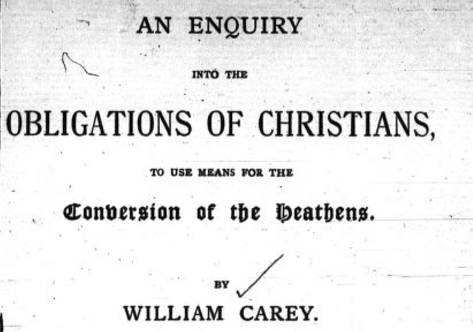
William Carey Enquiry Book Cover

Review: An Enquiry into the Obligations of Christians to Use Means for the Conversion of the Heathens

 Rating: ★★★★★

Who: William Carey, British missionary to India, known as “the father of modern missions.” He is also noted for his linguistic works and Bible translations in Bengali, Marathi, and several other languages.

When: 1792, one year before William Carey left for his mission field in India.

Overview:

This pamphlet did lead directly to the founding of the Baptist Missionary Society. Encyclopedia Brittanica calls this pamphlet “the charter of Protestant missions.” That is a just assessment as it concerns certain mainstream and evangelical Protestant groups. However, this can’t be stated without giving due honor to Lutheran pioneers, such as Hans Egede and Ziegenbalg, or the Moravians, such as Leonard Dober; all of these preceded Carey by some decades. In 1710, August Francke was training a ten-year-old Count Zinzendorf, circulating missionary newsletters for the Danish Tranquebar Mission, and printing Bibles in various languages, more than fifty years before Carey was born.

While it’s more often referenced than read today, Carey’s arguments are surprisingly current and readable.

Carey argues first that the Great Commission is Christ’s mandate to all his disciples, not just the Eleven (Section I); then he gives a summary of how Christianity grew through missions work, in the Book of Acts as well as over the centuries (Section II); the third section summarizes the state of missions in his day; the fourth section debunks a series of objections in the way of missionary service; and, the last section explains the duties of all Christians to further missions work by prayer and finances.

Meat:

The first part of Carey’s pamphlet argues persuasively that the commissions of Jesus apply to all Christians, not just the apostles. His arguments in this section are timeless and should be discussed even at the present time. Jesus has not repealed or amended the Great Commission; it stands binding on all his followers.

Carey also has some great reminders about missionary hardship. (He encourages his readers that the invention of mariner’s compass has made travel much more certain!) He points out with conviction—Livingstone noted the same in Africa—that traders will undergo any hardship for the single goal of riches; Christians with a single goal should likewise “act with all their might,” without fear, in the pursuit of this all-encompassing goal. (See quote below from p. 82.)

Bones:

It is difficult to make heads or tails of Section III, Carey’s survey of the state of world missions, which is replete with obsolete place names; even the data itself is questionable. Section II might also seem superfluous to many readers, although the history itself is well done.

Quotes:

“Where a command exists nothing can be necessary to render it binding but a removal of those obstacles which render obedience impossible, and these are removed already.” (On the Great Commission, p. 11)

“After all, the uncivilized state of the heathen, instead of affording an objection against preaching the gospel to them, ought to furnish an argument for it.” (p. 69)

“It is inconsistent for ministers to please themselves with thoughts of a numerous auditory, cordial friends, a civilized country, legal protection, affluence, splendour, or even a competency. The flights, and hatred of men, and even pretended friends, gloomy prisons, and tortures, the society of barbarians of uncouth speech, miserable accommodations in wretched wildernesses, hunger, and thirst, nakedness, weariness, and painfulness, hard work, and but little worldly encouragement, should rather be the objects of their expectation. ” (p. 72)

“When a trading company have obtained their charter they usually go to its utmost limits. … They cross the widest and most tempestuous seas, and encounter the most unfavourable climates; they introduce themselves into the most barbarous nations, and sometimes undergo the most affecting hardship. … Christians are a body whose truest interest lies in the exaltation of the Messiah’s kingdom. Their charter is very extensive, their encouragements exceeding great, and the returns promised infinitely superior to all the gains of the most lucrative fellowship. Let then every one in his station consider himself as bound to act with all his might, and in every possible way for God.” (p. 82)


What to Read for Lent 2017

As Lent approaches, here are three recommendations for getting into the spirit of the season:

  1. When God Died by Herbert Lockyer
    Herbert Lockyer wrote these 12 meditative sermons specifically for the Lent season, which culminates in the commemoration of the Holy Week and the death and resurrection of Jesus. The sermons focus, though, on the meaning of the crucifixion of Jesus. These classic sermons by Herbert Lockyer were out of print for more than 75 years, and have been republished by Pioneer Library.
  2. The Loneliness of Christ by Robert Keable
    This Catholic author wrote a stirring devotional about a seldom-explored side of Jesus’ life: loneliness. Lent is typically focused towards the cross and resurrection of Christ, but it also commemorates his temptation in the desert. Jesus’ loneliness is part and parcel of his work as our Forerunner, our Captain, and our Savior.
  3. Concerning Christ’s Temptations by Thomas Fuller
    If you love Puritan literature, you should definitely check out Thomas Fuller. He is a 17th-century Chesterton, combining unexpected insight with a witty turn of phrase. Puritan writers love to turn Scripture over and over, drawing all that they can from it. These twelve sermons were originally published more than 350 years ago, but they have been edited and footnoted to make them a little easier for modern readers.
  4. Sign up for Lent devotions from Pioneer Library
    This Lent, Pioneer Library will be publishing short Lent devotionals to encourage meditation on the temptations of Jesus. “For we do not have a high priest who is unable to sympathize with our weaknesses, but one who in every respect has been tempted as we are, yet without sin.” (Heb. 4:15) This is the key verse to this devotional, which takes an inward look at the experience of Jesus in each of the three temptations. If the Holy Spirit led him to and through temptation in victory, he can do the same for us.

If you want to receive devotionals on the desert temptations of Jesus, you can sign up your email address by typing it in the sidebar to this page.

Uganda's White Man of Work book cover

Review: Uganda’s White Man of Work

Rating: ★★★★★

Who: The main subject of this biography is Alexander MacKay, English pioneer missionary to Uganda, but we also hear about Henry Stanley, Robert Ashe, Bishop James Hannington, the Uganda Martyrs, and many others.

The author, Sophia Lyon Fahs, was born to Presbyterian missionaries in China. This is her only missionary biography.

Where: The Kingdom of Buganda, the predecessor to today’s Uganda.

When: 1849-1890. (Published 1907.)

Overview: Alexander MacKay was a practical pioneer missionary to Uganda. His missions group required a litany of practical skills to survive and thrive in Uganda: road-building, carpentry, farming, and teaching, to name a few.

He was invited by the Ugandan king, Muteesa I, and was able to stay longer than many of the other missionaries he worked with, though it was only 12 years. He suffered much at the hands of the vacillating kings of Uganda, who one day said that the religion of Christ was the best, and the next executed missionaries for fear of an outside invasion. The kings also pandered for many years to Arab traders, who conspired against the missionaries, traded in guns and slaves, and sought to promote Islam. The missionaries seemed especially successful, though, in their literacy programs, which were a great service to Ugandans. Despite persecution and martyrdom, the story is by and large a triumph of modern missions.

This book was written for a younger audience, so the story is quite easy to follow.

Meat: The reason this book gets five stars is its scope. The book is almost a condensed history of Ugandan missions. Rather than merely celebrating the work of one man, the author shares the stories of others which both preceded and followed that of MacKay. Before MacKay came, Henry Stanley—the same Stanley that found Livingstone—was told by Uganda’s king to send missionaries to share the Christian message in full with him. In passing, we hear the story of Bishop Hannington, and the Uganda Martyrs, who were executed by King Mwanga II between 1885 and 1887. Finally, we catch a glimpse of the stage of the tremendous church growth in Uganda in 1900.

Bones: This book might simplify or skim over some of the stories; we cannot assume, for example, that all of Uganda’s churches are healthy, or that it has no need of missionaries today.

Listen: Listen for free on LibriVox or iTunes.

Read: Download the PDF for free on Archive

Review: A Grief Observed

Rating: ★★★★

Who: C. S. Lewis, British scholar and lay theologian.

When: 1961, following his wife’s death in 1960. They had been married for just four years.

Overview: Later in life, Lewis married Joy Davidman, a prominent author in her own right. She was snarky, academic, and just what Lewis wanted. But after only a few years together, she was diagnosed with cancer; after prayer, Lewis thought she was recovering, but the cancer returned, and, in a short time, she died.

A Grief Observed is C. S. Lewis’ shortest and most confessional book, pulled from his journals in his time of intense grief. Publishers call these his “reflections,” but that makes them sound like a leisurely or imaginative read, which they are not. This book’s value is not informational, but formational. There is progression, but no steps; doctrine, but no instruction.

Meat: Many people going through grief say that this book simply resonates with their difficulties. Sudden grief often leads to trust issues, and Lewis had his fair share, after marrying so late in life, and being so suddenly bereaved. The passage that resonated most with me is about the sense of being emotionally overwrought, so that grief makes you unable to know God’s nearness. (See the last quote, below.) These common experiences, though seldom spoken of, are the lot of many in grief. Nevertheless, “blessed are those who mourn, for they will be comforted.”

Bones: These journal entries were not really intended for publication, so they are honest in the extreme. Lewis himself wrote that they were a product of his experience, and do not fit with his other “popular theology” books. I’ll pass on the advice I received about this book: don’t read it until you’re going through true grief.

Quotes:

“The time when there is nothing at all in your soul except a cry for help may be just the time when God can’t give it: you are like the drowning man who can’t be helped because he clutches and grabs. Perhaps your own reiterated cries deafen you to the voice you hoped to hear.” (ch. 3)

“What do people mean when they say, ‘I am not afraid of God because I know he is good’? Have they never even been to a dentist?” (p. 61, ch. 3)

“We were promised sufferings. They were part of the program. We were even told, ‘Blessed are they that mourn,’ and I accept it. I’ve got nothing that I hadn’t bargained for. Of course it is different when the thing happens to oneself, not to others, and in reality, not imagination.”

“Delicious drinks are wasted on a really ravenous thirst. Is it similarly the very intensity of the longing that draws the iron curtain, that makes us feel we are staring into a vacuum when we think about our dead? ‘Them as asks’ (at any rate ‘as asks too importunately’) don’t get. Perhaps can’t. And so, perhaps, with God, I have gradually been coming to feel that the door is no longer shut and bolted. Was it my own frantic need that slammed it in my face? The time when there is nothing at all in your soul except a cry for help may be just the time when God can’t give it: you are like the drowning man who can’t be helped because he clutches and grabs. Perhaps your own reiterated cries deafen you to the voice you hoped to hear.

On the other hand, “Know and it shall be opened.” But does knocking mean hammering and kicking the door like a maniac? And there’s also “To him that hath shall be given.” After all, you must have a capacity to receive, or even omnipotence can’t give. Perhaps your own passion temporarily destroys the capacity.” (p. 63-64)

Review: Perelandra (No Spoilers)

Rating: ★★★★★

Overview: Dr. Ransom makes his second journey “through deep heaven” in this novel, and becomes embroiled in a conflict that could decide the fate of the entire planet of Perelandra.

Lewis’ second installment of his Space Trilogy has much more theological meat in it, and for that reason, is the clear favorite of most theologically inclined readers. Perelandra will make the first book seem simplistic in comparison.

Meat: Out of the Silent Planet imagines a race that has never known sin; Perelandra deals with the intrusion of temptation on such a race. The result is a wealth of insight on both the Fall of Man as a doctrine and resisting temptation as a practice. Unlike the other two books in the series, in Perelandra Ransom’s inner dialogue provides a voicebox for extended theological discussion.

Bones: In my opinion, this might be C. S. Lewis best theology, but it’s wrapped up in a science fiction package. Some of Ransom’s dialogues would fit just as well on the “Christian Living” or “Philosophy” shelf at Barnes and Noble, and that is both the strength and the great criticism of this book, in particular, within the Space Trilogy.

Quotes: “Whatever you do, he will make good of it. But not the good he had prepared for you if you had obeyed him.” (ch. 9)

“Maleldil can make good use of all that happens but the loss is real.” (ch. 12)

“The world is so much larger than I thought. I thought we went along paths–but it seems there are no paths. The going itself is the path.” (ch. 14)

“I think he made one law of that kind in order that there might be obedience. In all these other matters what you call obeying him is but doing what seems good in your own eyes also. Is love content with that?” (ch. 16)

“Why did no miracle come? Or rather, why no miracle on the right side? For the presence of the Enemy was in itself a kind of Miracle. Had Hell a prerogative to work wonders? Why did Heaven work none? Not for the first he found himself questioning Divine Justice. He could not understand why Maleldil should remain absent when the Enemy was there in person. But while he was thinking this, as suddenly and sharply as if the solid darkness about him had spoken with articulate voice, he knew that Maleldil was not absent. …

‘It’s all very well … a presence of that sort! But the Enemy is really here, really saying and doing things. Where is Maleldil’s representative?’ The answer which came back to him, quick as a fencer’s or tennis player’s riposte, out of the silence and the darkness, almost took his breath away. It seemed blasphemous. ‘Anyway, what can I do?’ babbled the voluble self. ‘I’ve done all I can. I’ve talked till I’m sick of it. It’s no good, I tell you.’ He tried to persuade himself that he, Ransom, could not possibly be Maleldil’s representative as the Un-man was the representative of Hell. The suggestion was, he argued, itself diabolical – a temptation to fatuous pride, to megalomania. He was horrified when the darkness simply flung back this argument in his face, almost impatiently….” (ch. 18)

Review: The Passing of John Broadbanks

Rating: ★★★★★

Who: F. W. Boreham, British pastor and author of more than 50 books. He spent most of his life pastoring in New Zealand and Australia. (See the article “Who Is F. W. Boreham?”)

Genre: On Boreham’s spiritual essays: F. W. Boreham is difficult to place into a genre. A reviewer wrote in Preacher’s Magazine, “There is only one Boreham.” His writing is a mix of essay writing and what I call “literary preaching”—preaching that is intensely informed by both Christian and classic literature. In the main body of his work (“classic Boreham”), some chapters were originally sermons; others were culled from his 3000 biographical essays. In any case, most of his 49 books are a goldmine of suitable (if light) devotional reading. (See my guide to his published works.)

Overview: Very few of F. W. Boreham’s devotional books have clear themes; this is an exception. Many of the sermons run on the themes of the passage of time, the metaphor of life as a journey, and the approach of eternity. His overall method is to treat whatever metaphors, stories, and life parables present themselves to him.

Meat: “Our Second Wind” is among the best chapters in any of his books. “The Wayside Inn” and all of Part II is moving and memorable. Passing of John Broadbanks is one of the later books of his career, so his writing style is very clear and polished here.

Quotes: “Life’s choicest prizes are for the plodders.” (“Our Second Wind”, loc. 1694)

“The rending of the veil was not the desecration of the temple; it was the consecration of the world.” (“Beau Geste”, loc. 2475)

“The Kingdom of God demands of each man the dedication of his own individuality.” (“The Ordinand”, loc. 2604)

The Human Tree

Source: G. K. Chesterton, The Wild Knight & Other Poems

Many have Earth’s lovers been,
Tried in seas and wars, I ween;
Yet the mightiest have I seen:
Yea, the best saw I.
One that in a field alone
Stood up stiller than a stone
Lest a moth should fly.

Birds had nested in his hair,
On his shoon were mosses rare,
Insect empires flourished there,
Worms in ancient wars;
But his eyes burn like a glass,
Hearing a great sea of grass
Roar towards the stars.

From them to the human tree
Rose a cry continually:
‘Thou art still, our Father, we
Fain would have thee nod.
Make the skies as blood below thee,
Though thou slay us, we shall know thee.
Answer us, O God!

‘Show thine ancient fame and thunder,
Split the stillness once asunder,
Lest we whisper, lest we wonder
Art thou there at all?’
But I saw him there alone,
Standing stiller than a stone
Lest a moth should fall.

Review: Has Christianity Failed You?

Rating: ★★★★

Who: Ravi Zacharias, modern apologist and speaker. Ravi is the author of Can Man Live Without God? and many other books.

Overview: This book is one of Ravi’s lighter reads, and it deals with various points relating to doubt and suffering. This may sound like covering old ground, but books like Can Man Live Without God? deal with the rational basis for theism; Has Christianity Failed You? focuses on heart issues.

The main thrust of the book, in my opinion is two points: First, we are incapable of true transcendence, and must learn to cope with uncertainty. Second, God retains his right to act as he will, and is not bound to do everything we ask, even in prayer. Jesus did not solve all of the world’s problems, and did not promise to do so on this earth. He came to provide a way to the Father and a path to redemption.

We experience some miracles, but not all the miracles we want; we see some of God, but not all we would like. In the end, the hunt for miraculous transcendence leaves us where we started: asking for ‘just one more’ proof of God’s existence. We must obey the God that we know, rather than asking him to obey us.

Ravi gives the powerful example of John the Baptist in prison, sending a question to Jesus to ask if he is truly the Messiah. Jesus points to the miracles all around him, but does not stage a coup against Herod, or smuggle John out of prison, or perform a miracle in John’s behalf. So John dies because of the testimony of Jesus’ Messiahship—the Messiahship that delivered from sin, but not from pain.

Meat: The chapter on prayer is worth reading more than once. Frequently a loss of prayer life is the erosion of the foundation under the spiritual life, and if we can address its issues, we will not feel like Christianity has failed us. Some readers might be surprised when I say that Ravi is at his strongest when he gets to the heart issues, and we should not relegate him to the apologetics shelf.

Bones: Ravi brings a wealth of examples in this book—so many that sometimes I couldn’t follow the train of thought from point to point. Each chapter makes great points, but it was hard at times to see how they connected to one another. The chapter addressing “The Reason-Driven Life” almost felt like it was in the wrong book.

Quotes: “Virtually every great leader in the Bible struggled during times of testing or tension over what they thought God should do or say, even though they had recognized God’s divine intervention earlier.” (p. 77)

“At first blush, the miracle seems the only way to win a following. But the fickleness of the human mind, our insatiable desire to always want ‘just one more,’ the ever-present reality of need, our desire to play God and hence to control God, the apparent ‘hiddenness’ of God when we need him most—all these reasons that become even more urgent in intense situations make the plea for the arm to be reattached ‘just this once’ highly suspect.” (p. 77)

“If you a praying Christian, your faith in God is what is carrying you, through both the good times and the hard times. However, if you are not a praying person, you are carrying your faith, and trying to carry the infinite is very exhausting.” (p. 151)

Who Is F. W. Boreham?

I want to tell you about my favorite author: F. W. Boreham. If you asked him his profession, he would say he was a pastor; but he was superlative as a writer. You would think that I was joking if I told you that, when he was a child, a gypsy told his nanny that if she put a pen in his hand, he would never want for work. But it is a story that he laughed in recounting. He was among Charles Spurgeon’s last personally chosen students for his Bible school. When Charles’ brother, James Spurgeon, returned from New Zealand needing a replacement in those remote islands, Boreham accepted the charge. It was the start of a long life of ministry and writing in New Zealand and Australia.

In the early twentieth century, at a preachers’ conference, one preacher said of F. W. Boreham that his books were on all their shelves, his name was on all their lips, and his illustrations were in all their sermons. Many years later, in 1959, Ruth Graham, wife of Billy Graham, said that she had read almost all of his books and was in the process of acquiring and finishing the last few. While preaching in the area, Billy Graham made a special trip to visit this famous writer and preacher. Impeccable timing, as it turned out to be the last year of the author’s life.

 Today writer and apologist Ravi Zacharias reads an essay by him everyday. That is, some call them essays; others call them sermons. They straddle the line between preaching and storytelling; they are deep enough to be studied by a trained philosopher, creative enough to captivate anyone in need of a great story, inspiring enough to satisfy any Christian thirsty for living water.

I suppose Boreham’s writings should speak for him, although several eminent men have spoken for him too. Spurgeon, one of the 19th century’s greatest preachers, and an Englishman; Billy Graham, one of the 20th century’s greatest evangelists, an American; and Ravi Zacharias, one of the 21st century’s greatest apologists, an Indian—they all tipped their hat to this writer. Because of his long life and early commitment to read a book every week, he seems to quote or reference every famous Christian of his time, including not only preachers, but missionaries, inventors, scientists, storytellers, and adventurers.

F. W. Boreham wrote over 2000 biographical articles for an Australia newspaper during his lifetime, many of which were put into his books. With 52 full-length books and dozens of booklets to his name, he was, until 1990, the most prolific religious writer in Australia’s history. Today his readers agree that no one else has such a knack for taking a commonplace topic or story, and zooming out his lens until, at the end of almost every essay, you gain a glimpse of Christ that impels you to worship. He also had an unparalleled way of saving his punchline until you thought it would never come.

If all this sounds like creative hyperbole to you, then consult his writings for yourself; and tell me if he has ever been beaten in his superlative skill to take an ordinary topic and point you to an extraordinary Savior.

Of course, I can’t forget the one who taught Boreham all he knew. The rabbi who wrote no books and died young, but awed the world by using everyday stories, untapped Scripture insights, God’s creation, or mere questions. He found his sermons in a coin, a fig tree, a highway robbery, a shepherd, the flowers, the birds, the harvest, the weather—and among his loftiest subjects, a meal including bread and wine. Following in the God-man’s footsteps, Frank William Boreham had a perfect ally and ample approval to point from the creation to the Creator.