Review: Christus Victor

Rating: ★★★★★

Full title: Christus Victor: A Historical Study of Three Main Types of the Idea of the Atonement.

Author: Gustaf Aulén was a Swedish theologian known mainly for Christus Victor. In historical context, he is also part of a movement towards neo-orthodoxy in Swedish Lutheranism (the “Lundensian” movement).

Overview:

The book begins with the following statement:

My work on the history of Christian doctrine has led me to an ever-deepening conviction that the traditional account of the history of the idea of the Atonement is in need of thorough revision.

Aulén sees previous atonement literature as divided into two camps, while a third option has been overlooked since the Reformation. Many previous studies of the atonement used a dichotomy of two logical theories: the “objective” atonement theory (penal substitution) and the “subjective” atonement theory. Aulén’s book, however, traces atonement theory from a third, older view: the “classic” or “dramatic” view seen in Scripture and the Eastern Church Fathers, which is less logically rigorous but just as important. In a nutshell, the classic view is exemplified in the Narnia novel The Lion, the Witch and the Wardrobe, wherein the atoning triumph is specifically over evil forces, not against an angry deity. The triumph is also sometimes seen as an act of deception over the devil, who attacked Christ at Calvary, not knowing that such a violation of divine law would overthrow his own kingdom:

Christ—Christus Victor—fights against and triumphs over the evil powers of the world, the “tyrants” under which mankind is in bondage and suffering, and in Him God reconciles the world to Himself. Two points here require to be pressed with special emphasis: first, that this is a doctrine of Atonement in the full and proper sense, and second, that this idea of the Atonement has a clear and distinct character of its own, quite different from the other two types. (ch. 1)

In Aulén’s view, the atonement as conflict and triumph over Satanic forces (including sin and death) is the most prominent explanation in the New Testament and Church Fathers, and the objective and subjective theories are later attempts to iron out tensions in the New Testament’s account of atonement.

Thus, Aulén divides atonement history into:

1) The classic view (conflict and triumph), which was the usual explanation in the New Testament and the Church Fathers for the first millennium of church history;

2) The objective atonement (satisfaction theory or substitution), which was developed by Anselm of Canterbury in the 11th century and became the “orthodox” Protestant view;

3) The subjective atonement, which is typically credited to Abelard, a near contemporary and critic of Anselm. In Aulén’s view the subjective theory of the atonement is basically a reaction to the objective theory.

Meat:

Aulén’s book is tranquil where others are incendiary, brief where others are verbose, historical where others are critical. It has become key to the entire atonement controversy and should be discussed by modern theology students.

Key to Aulén’s book are the many quotes from Irenaeus, Anselm, Abelard, Luther, and others. He shows quite effectively that “conflict and triumph” is at the very least an underappreciated facet of Christ’s atonement. This was part of a movement of “re-Reformation,” in which Luther’s theology was re-appraised and some key concepts were given new treatments in Lutheranism. Aulén states in the fourth chapter that legal explanations of the atonement had become the only “orthodox” explanations:

The theologians of Protestant Orthodoxy took it completely for granted that the theory of the satisfaction of God’s justice was to be found everywhere in the New Testament, or, rather, that it was presupposed both in the New Testament and in the Old; in fact, it was primarily from the Old Testament that the “scriptural proofs” of the Atonement were primarily drawn, and this is a highly significant point. (ch. 4)

The goal in view in Christus Victor, however, is not to criticize satisfaction theory, but to revise “the traditional account of the history of the idea of the Atonement” (ch. 1).

There are some unique elements of the classical/dramatic atonement that come out in his study:

1) The classical view of the Atonement is a view, not a theory. Aulén contends:

[The classical view] is not a logically articulated theory of redemption but rather an idea, a motif, a theme, which is essentially one and the same in Paul and in the early church, but finds ever-varying forms of expression. (ch. 4)

2) The classical view brings the Incarnation to the forefront. Aulén points out that early explanations of the Atonement were indelibly bound together with Christ’s Incarnation. The legal view, however, is somewhat at odds with the Incarnation, and critics point out that penal substitution pits the Trinity against itself.

3) The classical view makes God the main actor in the Atonement. The legal view of the Atonement often makes God the object of the Atonement, whereas he is the Initiator of the Atonement in the classical view (2 Cor. 5:19). Aulén aptly summarizes this tension:

It may be summed up thus: The classic idea shows a continuity in the Divine action and a discontinuity in the order of justice; the Latin type, a legal consistency and a discontinuity in Divine operation. (ch. 5)

4) Finally, the classical view emphasizes a new order based on grace. The legal view makes the act of grace also an act of payment; in the classical view, God not only makes amends (in Christ) or accepts the means of making amends (in the Father), but he initiates a change in the universal order which we may freely appropriate by faith in Christ. He enables believers to live in freedom from the devil and death. Law does not triumph over law; rather, grace triumphs over law, and the tension in the divine order is palpable in the classical view:

The nerve of the whole is the idea of the Divine Love breaking in pieces the order of merit and justice, and creating a new order to govern the relation of man with God, that of Grace. (ch. 6)

This acceptance of paradox, which is the final note of triumph in Aulén’s conclusion, resonates both with Christian mysticism and with modern writers on paradox such as Gerald Kennedy (in The Lion and the Lamb: Paradoxes of the Christian Faith) and G. K. Chesterton (Orthodoxy).

Bones:

Aulén’s book is a potent challenge to proponents of substitutionary atonement. If the substitutionary atonement is so important, why is it only discussed during the second millennium of church history? Aulén probably doesn’t give proper weight to the Calvinist explanation, however. The options are these:

1) Aulén’s view: Substitutionary atonement is not mentioned during the 1st millennium A.D. because the dramatic view of the atonement was the dominant explanation.

2) The Calvinist view: Substitutionary atonement is not mentioned during the 1st millennium A.D. because there was no rigorous atonement theory.

As I see it, it would be shortsighted to say that there was “no theory” for 1000 years. This may be just another way of saying that explanations of the Atonement didn’t have all their kinks ironed out, which Aulén freely admits. But the fact of the Atonement was passed on from generation to generation, even in Britain’s medieval mystery plays, with a clear conflict and triumph motif. It cannot be passed on in a vacuum, just as anyone who says they have “no theology” just means that they do not know what theology they have.

Aulén manages to play to the strength of this problem by claiming that the classical/dramatic view is not logically rigorous; but I only mention it to point out that his explanation of this problem could be teased out in a longer work.

Quotes:

“The New Testament teaching corresponds with that of the early church; it being understood that there is not to be found in either case a developed theological doctrine of the Atonement, but rather an idea or motif expressed with many variations of outward form.” (ch. 4)

“It is possible to fix with precision the time of the first appearance of the Latin theory. Tertullian prepares the building materials; Cyprian begins to construct out of them a doctrine of the Atonement.” (ch. 5)

“The Latin doctrine of the Atonement is closely related to the legalism characteristic of the medieval outlook.” (ch. 5)

“Satan’s triumph would be his undoing. This strange paradox, that He who was the stronger than Satan should succumb to the power of evil and thereby break it—this paradox was involved in His situation as the Son of Man in lowliness, but having His high vocation, and all the while an instrument of God’s will.” (quoting Anton Fridrechsen)

Wounded Healers

“They who, themselves, have trodden with bleeding feet the Via Crucis [Way of the Cross] know best how to pity. Thackeray wrote: ‘Most likely the Good Samaritan was a man who had been robbed and beaten on life’s road and knew what it was to lie stripped and bruised by the wayside.’ The superintendent of a large hospital reports that most of the gifts for buildings or endowments come from bereaved or otherwise afflicted people. It is said that most of the improvements in artificial limbs have been invented by the first man who lost a limb on the Confederate side in our Civil War [James Edward Hanger]. Out of his crippled condition benefits have emerged for thousands of maimed. Out of Senator Leland Stanford’s loss of his only child came limitless benefit to endless generations of boys by the building of Leland Stanford, Jr., University. Out of A. R. Crittenton’s loss of a loved daughter came his impulse to father thousands of friendless girls by the establishment of Florence Crittenton Homes in near a hundred cities for a class most in need of true friends and least likely to have them. Out of George Matheson’s bitterest hour of anguish comes one of the great hymns of the ages to comfort the anguish of countless souls with the ‘Love that wilt not let me go.’ . . . It was because Miss Sullivan had suffered an attack of blindness lasting several years that she was moved with sympathy toward a little blind deaf-mute child in Tuscumbia, Alabama; whereby Helen Keller got a teacher who brought her out of darkness into the marvelous light of a wonderful life.”

Source: William Valentine Kelley, A Salute to the Valiant

Did C. S. Lewis Really Say That?

How You Can Help End the Flood of False Quotations

The monetization of social media, especially Facebook and Instagram, has depended largely on visual media, meaning that motivational quotes, once posted as status updates, now get posted as images or even videos. The reason for this is that Facebook intentionally privileges visual media, because it keeps readers engaged for longer times, which ultimately means more ad revenue.

Without the text readily available, few people would re-type it to check if the quote is real. This is taxing work for Christian writers and media editors who want to have an influence on social media, but don’t want to reinvent the wheel.

Fortunately, it has become easier and easier to find original sources, since so many modern books are in digital (i.e. searchable) formats.

I’m going to illustrate my process for checking the original source of quotes, using a C. S. Lewis quote that I found near the top on a simple Google Image search. Vetting a quote usually takes just five to seven minutes, and it can save you a lot of pain if you are publishing a book or article, and don’t want to embarrass yourself by finding out after the fact that one of your quotations was spurious.

If you found an interesting quote or phrase, but you think it might be fake, here’s what you can do to find out for sure:

1. Check for a primary source.

1cs_lewis_1016_slide5

This image is taken from a slideshow on the Guideposts website called 10 Inspiring C.S. Lewis Quotes. In the case of our featured image, it has a small Guideposts watermark; however, I am pretty sure that C. S. Lewis did not write for Guideposts, so our quote clearly comes without a primary source.

2. Run a simple Google search.

If you are searching for a quote, be sure to put it inside quote marks. For less famous quotations, those quote marks are really important.

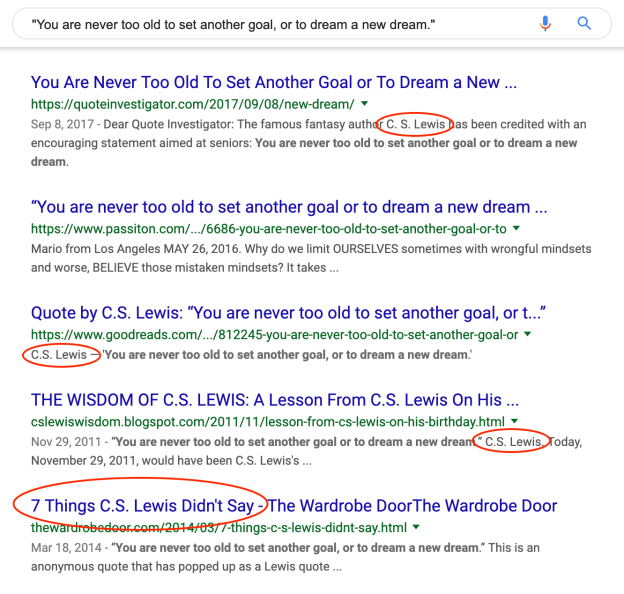
The purpose of running a basic web search is to scan for primary sources, and to see if it’s widely attributed to anyone else. So leave out the author’s name and see if Lewis comes up.

asdf.png

Here it’s most widely attributed to C. S. Lewis, but we can already see someone has listed it as something “C. S. Lewis didn’t say.” They could be wrong, though; C. S. Lewis wrote more than 20 books, some of which are not easy to find, and many of his letters were published after his death. So we will finish our quick search.

3. Search Google Books.

Google Books is a game changer when you’re searching for a quote, because, unlike other sources, it includes even brand new books. Blogs are nice and all, but we want to know what is the earliest published source of this very famous quotation.

4. Sort by date on Google Books.

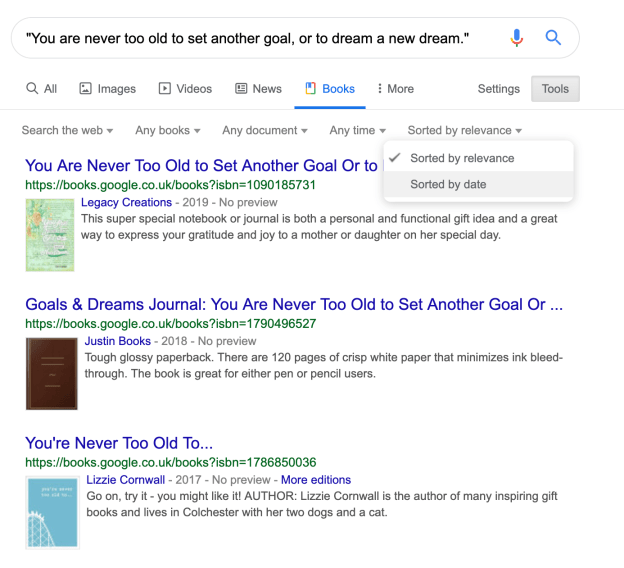
Google Books allows you to sort by date, which means we can find easily look for the earliest published source there.

Screenshot 2019-06-14 11.03.53.png

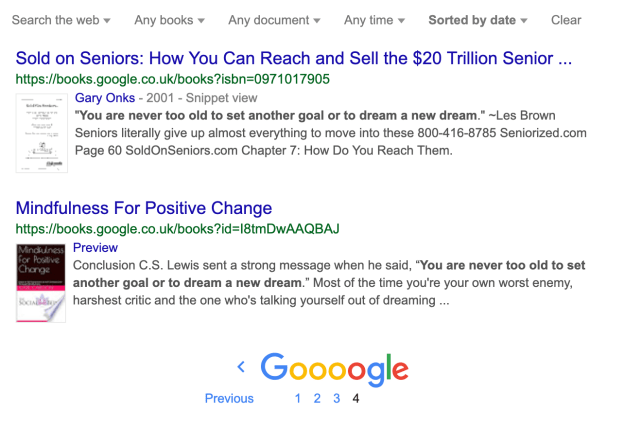
Google’s “sort by date” function can be a little dodgy. For some reason, it only goes in one direction, so if you want to find the earliest source, you’ll have to click the last number. “Sort by date” also filters out results that have no date, which can cause some wonky effects.

Untitled.png

After we click on the last page in our sorted search, we can see the dates of publication. In this search, the second link appears to be an ebook, with no date, so our earliest available source on Google Books is a 2001 book by Gary Onks called Sold on Seniors.

Screenshot 2019-06-14 11.06.16.png

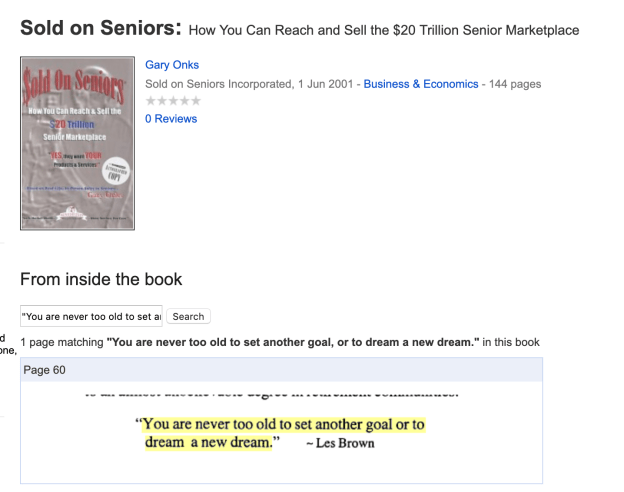
Now, the fact that the quote dates only to 2001 on Google Books should already clue us in that C. S. Lewis most likely didn’t say this, since he died in 1963. Fifty years is generally a long time for a quote to suddenly resurrect and become popular. Click on the book’s title for the details, and you’ll see the quotation in Google Books’ “Snippet View”:

Screenshot 2019-06-14 11.06.45.png

Bingo. In 2001, it was attributed to Les Brown, and afterwards, it somehow became misattributed to C. S. Lewis.

This simple process on Google Books is the quickest way to check who first originated a pithy saying. (And Google’s Ngram Viewer is also a great way to check on the origin of an idiom or phrase.)

Tip: If you’re still stuck on Google Books, and web searches, try shortening to only include half the quote. It only takes a few words to pinpoint a unique saying.

Now that I’ve shown you how I check a quote, here is an overall rating of Guideposts’ 10 Inspiring C.S. Lewis Quotes:

1. You are never too old to set another goal, or to dream a new dream.

✖ NOT C. S. LEWIS (0.0 / 1.0)

As seen from our detailed search, this quote actually originates from Les Brown, a motivational speaker. (Further research has shown that it was first printed in one of his books in 1998.)

2. Love is unselfishly choosing for another’s highest good.

✖ NOT C. S. LEWIS (0.0 / 1.0)

A search on Google Books uncovers only four sources, starting in 2009. Incidentally, I remembered that Oswald Chambers had used the phrase “highest good”; this turns out to be the title of one of his books. Chambers says that “the highest good” is a phrase or concept that he adapted from Aristotle; and, whoever originated the above quote, may have adapted or paraphrased the quotation from Chambers’ book.

3. There are far, far better things ahead than any we leave behind.

✖ PARAPHRASED (0.5 / 1.0)

Fortunately, William O’Flaherty has done the legwork for us on this one, and he tells us the original quote, with context, is:

Can you not see death as the friend and deliverer? . . . Has this world been so kind to you that you should leave it with regret? There are better things ahead than any we leave behind.

O’Flaherty points out that Lewis’ meaning suffers by being divorced, not only from its literal context, but from its historical context:

[These words] are found in a letter Lewis wrote to Mary Willis Shelburne on June 17, 1963. It’s available in The Collected Letters of C.S. Lewis, Volume 3.
Ironically, Lewis would die less than five months later. This is ironic because his words are part of comments expressed to Shelburne to comfort her as she was in the hospital and it was thought that her days were numbered. She actually went on to live twelve more years!
When you read the actual letter Lewis penned to Shelburne you find that early on he is challenging her about being fearful of dying by saying, “Can you not see death as the friend and deliverer?” At the close of the same paragraph he states “Has this world been so kind to you that you should leave it with regret? There are better things ahead than any we leave behind.”

4. Do not let your happiness depend on something you may lose.

✅ AUTHENTIC—BUT OUT OF CONTEXT! (0.5 / 1.0)

This one is quite odd, because in context, Lewis is actually paraphrasing Augustine, but goes on to say that he disagrees with him! To Lewis’ mind, Augustine is advocating a kind of “emotional safety” after the death of his friend Nebridius. But Lewis believes that God emphatically directs us away from such safety by commanding us to love. “To love at all is to be vulnerable,” he writes.

(You can read the full passage here.)

5. Hardship often prepares an ordinary person for an extraordinary destiny.

✖NOT C S LEWIS (0.0 / 1.0)

This quote actually from the 2010 film adaptation of The Voyage of the Dawn Treader, so it did not originate with Lewis himself. Christopher Markus, Stephen McFeely, and Michael Petroni were the screenwriters.

6. Friendship is born at that moment when one person says to another: “What! You too? I thought I was the only one.”

✖ PARAPHRASED (0.5 / 1.0)

The order of this quote was inverted from The Four Loves, in the chapter on “Friendship”:

The typical expression of opening Friendship would be something like, “What? You too? I thought I was the only one.” . . . It is when two such persons discover one another, when, whether with immense difficulties and semi-articulate fumblings or with what would seem to us amazing and elliptical speed, they share their vision—it is then that Friendship is born.

7. We meet no ordinary people in our lives.

✖ PARAPHRASED (0.5 / 1.0)

If you look for this exact quote, you will not find C. S. Lewis saying it anywhere. The quote is short enough that there is no sure way of knowing who originated the paraphrase; but the actual quote is from a famous passage in The Weight of Glory—one of Lewis’ most underrated books:

There are no ordinary people. You have never talked to a mere mortal.

The full passage is an eloquent statement of the eternity of every human soul, whether saved or damned.

8. You can’t know, you can only believe—or not.

✅ AUTHENTIC (1.0 / 1.0)

This quote is from The Voyage of the Dawn Treader. Some overly theological readers might think that Lewis was advocating a Kierkegaardian “leap of faith”—however, probably, he just wanted to point to young readers that we can move forward without 100% certainty.

9. We must lay before him what is in us; not what ought to be in us.

✅ AUTHENTIC (1.0 / 1.0)

This comes from Letters to Malcolm: Chiefly on Prayer, Letter 4. The quote itself is very similar to ideas found in the theology of George MacDonald, wherein MacDonald directs his readers to draw near to God in all circumstances, and not to endeavor to “clean themselves up” before approaching God in prayer.

10. Believe in God like you believe in the sunrise. Not because you can see it, but because you can see all it touches.

✖ PARAPHRASED (0.5 / 1.0)

This one is really a very odd paraphrase, and a Google search gives only a few inspirational websites and blogs. The actual quote is:

I believe in Christianity as I believe that the Sun has risen, not only because I see it but because by it, I see everything else.

The original quote comes from “Is Theology Poetry?”, one of Lewis’ addresses in The Weight of Glory. Lewis himself was paraphrasing a profound analogy used by G. K. Chesterton decades earlier, in the concluding paragraph of “The Maniac,” a famous chapter in Orthodoxy. So Lewis may have originated this pithy saying, but he probably took the analogy—consciously or unconsciously—from Chesterton, who had a profound influence on him.

Here is Chesterton’s analogy, which is couched in a more poetic style:

Symbols alone are of even a cloudy value in speaking of this deep matter; and another symbol from physical nature will express sufficiently well the real place of mysticism before mankind.  The one created thing which we cannot look at is the one thing in the light of which we look at everything. Like the sun at noonday, mysticism explains everything else by the blaze of its own victorious invisibility. . . . But that transcendentalism by which all men live has primarily much the position of the sun in the sky. We are conscious of it as of a kind of splendid confusion; it is something both shining and shapeless, at once a blaze and a blur.

Conclusion

The final score was 4.5 out of 10, with several very generous half-points awarded. Overall, this Guideposts slideshow of 10 quotes included only 3 authentic C. S. Lewis quotes, and one of them was so out of context that it was Lewis explaining an argument he didn’t agree with.

Based on this slideshow, chosen at random, it is very discouraging to think that only 30% of the quotes attributed to C. S. Lewis on that slideshow were actually said or written by C. S. Lewis. It just goes to show that there are two ways to get a quote to spread on the Internet:
1. It needs to be a simple, positive message;
2. It needs a name like C. S. Lewis to give it an almost papal authority.


Free Books by A. W. Tozer

Most of Tozer’s books are still under copyright, but a few happen to be in the public domain, including the classic The Pursuit of God. Although that’s the only one that’s in multiple formats, I’m leaving these links here in case more of them show up in the future (like Total Commitment to Christ, or How To Be Filled with the Holy Spirit).

Helpful tip: If you’re in a pinch, you can borrow many Tozer books with digital library access from the Internet Archive. All you have to do is sign up, and you can borrow a book for two weeks at a time.

Free A. W. Tozer books (PDF) on the Internet Archive (10+)
Free A. W. Tozer audiobooks on LibriVox
Free A. W. Tozer books on Project Gutenberg

8 Best Websites for Free Books

In general, if you’re looking for free books, the best places to look are the following, in order of usefulness:
  1. The Online Books Page
    A huge handmade database that aggregates freely available books in all formats, especially from major sites listed below like Google Books, HathiTrust, and the Internet Archive. It is the most useful because you can find comprehensive lists arranged by author, although, for our favorite authors, listed above, we have compiled even better lists here.
    Especially good for: Books organized by author
  2. The Internet Archive (archive.org)
    A massive media archive based in San Francisco, housing mainly public domain materials. The Internet Archive includes digitized library resources, like Google Books, but also includes other media forms like video and audio. Many public domain books from Google Books have been re-uploaded on archive.org, but not nearly all. It is also sometimes prone to religious propaganda or spam, so you may have to tailor your searches.
    Europe has more Internet restrictions and stricter copyright laws, so you will have the best luck if you are logged in from the United States or Canada.
    Especially good for: Any book from 1850 to 1923
  3. Google Books
    Google Books contains millions of digitized books, including both public domain and in copyright. Google Books often has the best collection of very old materials, i.e., before 1850. If you are looking for a rare Puritan work, a very rare hymn, or something from William Carey’s day, Google Books is often the best place to start.
    I also have written a guide to hunting for rare quotes, which works best on Google Books for numerous reasons.
    Especially good for: Magazines, periodicals, anything pre-1850
  4. Project Gutenberg
    Project Gutenberg is the best place to find books in epub and mobi formats, as well as rich-text format or plain text files, all of which are kilobytes instead of megabytes, and have many advantages over reading PDFs.
    Especially good for: Reflowable and searchable formats (epub, mobi, rtf, txt)
  5. LibriVox (for audiobooks only)
    LibriVox is the best source for public domain audiobooks. Occasionally, there are public domain books on LibriVox that are not available in any of these other sites; but, usually, they are popular titles that are already on Project Gutenberg and elsewhere. Often, I find that books that are free on Kindle will end up on LibriVox, so it is nice to switch back and forth, and use the Kindle to annotate or highlight the book as you listen.
    Especially good for: Fiction and adventure
  6. HathiTrust Digital Library
    HathiTrust is similar to Google Books and the Internet Archive, but, like Google Books, it also includes some books with use restrictions. So, sometimes you will find a newer book listed, but you won’t be able to access, or it will ask for an institutional (i.e. library or university) login, or perhaps the file will be read-only.
    Like the Online Books Page, HathiTrust has wealth of metadata, like author’s birth and death date, which makes it easier to find out if you are looking at the right title or not.
    Especially good for: Pamphlets
  7. Amazon’s Kindle Store
    When the Kindle Store began, there was a huge selection of free ebooks; however, all of these were taken directly from Project Gutenberg, so there’s no unique free material. Amazon was also swarmed from 2013 to 2015 by piggybacking public domain publishers, which caused a number of problems when readers are searching for older books—there would be dozens of Kindle editions, with no available rationale for choosing between them. This debacle has unfortunately become the status quo for lovers of resurrected books, since Amazon has continued to change its indexing in ways that only mask the free editions and promote more expensive ones. You can type “free” in the search bar, but it won’t limit your search to free titles.
    For the authors listed above, you will find that we have personally curated lists of Amazon’s free ebook editions, wherever available.
    Especially good for: Quick access & syncing
  8. U-M Library Digital Collections
    The University of Michigan has a fantastic collection of digitized books, but it’s not a good place to start looking. Usually, I end up on U-M’s digital collection because I am looking up a quote from poets and Puritans.
    However, it belongs on this list because I frequently find very rare or very old books there that are not available anywhere else. They have digitized books in their collection that are virtually impossible to even read anywhere else.
    Especially good for: Very old books, 17th and 18th century

Free Books by Joseph Parker (PDFs)

The following is an alphabetical list of publications by Joseph Parker, D.D., preacher of City Temple, London, with links to PDF copies where available.

Joseph Parker was one of the most prolific writers of the century. More than 60 volumes of his writings are hyperlinked below. About half a dozen others have not been digitized—the complete list is available here. Parker’s output is certainly comparable to that of his friend, Charles Spurgeon. Nearly all of these books are above 300 pages, and there is no way of guaranteeing that this is all that he published, since some of them are very rare.

Most of these books are out of print, but we have worked tirelessly to make his crowning work, The People’s Bible, widely available in digital format.

  1. Ad Clerum
  2. Apostolic Life, As Revealed in the Acts of the Apostles (also published as vol. 23-25 of The People’s Bible)
    vol 1: [Acts 1-12] From the Ascension of Christ to the Withdrawal of Peter;
    vol 2: [Acts 13-19];
    vol 3: [Acts 20-28].
  3. The Ark of God: The Transient Symbol of an Eternal Truth
  4. The Cavendish Hymnal, Compiled for Use in Homes and Churches. [Compiler.]
  5. The Chastening of Love: Words of Consolation for the Christian Mourner
  6. Christian Profiles in a Pagan Mirror
  7. Church Questions
  8. The City Temple: Sermons (also published individually as pamphlets)
  9. Ecce Deus: Essays on the Life and Doctrine of Jesus Christ
  10. Emmanuel
  11. Helps to Truth-Seekers
  12. Hidden Springs
  13. A Homiletic Analysis of the Gospel of Matthew
  14. The Inner Life of Christ as Revealed in the Gospel of Matthew
    vol 1: “These Sayings of Mine”;
    vol 2: “The Servant of All”;
    vol 3: “Things Concerning Himself.”
  15. Might Have Been: Some Life Notes
  16. None Like It: A Plea for the Old Sword
  17. The Paraclete: An Essay on the Personality and Ministry of the Holy Ghost
  18. Paterson’s Parish: A Lifetime amongst the Dissenters (fiction)
  19. The People’s Bible (27 volumes of sermons)
    vol 1: Genesis;
    vol 2: Exodus;
    vol 3: Leviticus to Numbers 26;
    vol 4: Numbers 27 to Deuteronomy;
    vol 5: Joshua to Judges 5;
    vol 6: Judges 6 to 1 Samuel 18;
    vol 7: 1 Samuel 18 to 1 Kings 13;
    vol 8: 1 Kings 15 to 1 Chronicles 9;
    vol 9: 1 Chronicles 10 to 2 Chronicles 20;
    vol 10: 2 Chronicles 21 to Esther;
    vol 11: Job;
    vol 12: Psalms;
    vol 13: Proverbs;
    vol 14: Ecclesiastes to Isaiah 26;
    vol 15: Isaiah 27 to Jeremiah 19;
    vol 16: Jeremiah 20 to Daniel;
    vol 17: Hosea to Malachi;
    vol 18: Matthew (The Inner Life of Christ vol. 1, “These Sayings of Mine”);
    vol 19: Matthew (The Inner Life of Christ vol. 2, “Servant of All”);
    vol 20: Matthew (The Inner Life of Christ vol. 3, “Things Concerning Himself”);
    vol 21: Mark and Luke;
    vol 22: John;
    vol 23: Acts [1-12] (Apostolic Life Revealed in the Acts of the Apostles, part 1);
    vol 24: Acts [13-19] (Apostolic Life Revealed in the Acts of the Apostles, part 2);
    vol 25: Acts [20-28] (Apostolic Life Revealed in the Acts of the Apostles, part 3);
    vol 26: Romans to Galatians;
    vol 27: Ephesians to Revelation.
  20. The People’s Family Prayer Book
  21. Preacher’s Life: An Autobiography and an Album
  22. The Priesthood of Christ: A Restatement of Vital Truth
  23. Pulpit Notes: With an Introductory Essay on the Preaching of Jesus Christ
  24. Six Chapters on Secularism
  25. Springdale Abbey: Extracts from the Diaries and Letters of an English Preacher (fiction)
  26. Studies in Texts (vol 1, vol 2, vol 3, vol 4, vol 5, vol 6) [full text is on Kindle]
  27. Today’s Bible
  28. Tyne Chylde: My Life and Teaching (fiction?)
  29. Tyne Folk: Masks, Faces, and Shadows (fiction?)
  30. Walden Stanyer, Boy and Man (fiction)
  31. Weaver Stephen: Odds and Evens in English Religion (fiction)
  32. Wednesday Evenings in Cavendish Chapel: Homiletic Hints
  33. Wilmot’s Child (fiction, under a pseudonym)
  34. The Working Church: An Argument for Liberality and Labour

In addition to the above, many of Parker’s sermons and speeches were published in pamphlets or small volumes:

  1. American War and American Slavery: A Speech
  2. Job’s Comforters: Scientific Sympathy
  3. Ingersoll Answered: “What Must I Do To Be Saved?”
  4. John Stuart Mill on Liberty: A Critique
  5. The Testimony of an Enemy: A Sermon to the Young
  6. A Word for the Present Crisis (search only)


Compilations:

  1. Detached Links: Extracts from the Writings and Discourses of Joseph Parker (compiled by Joseph Lucas)

Review: Man’s Search for Meaning

Author: The Bible speaks of men and women being made into “signs” by their unique circumstances, which demonstrate a truth about human life in the unarguable sphere of biography. Viktor Frankl’s life (1905-1997) is one such “sign.” Having not only lived through the gruesome Nazi concentration camps, but being a psychiatrist by profession, Frankl gleaned some comforting and noteworthy insights into human nature from what he learned there.

While many personal narratives have been written about the Holocaust, Frankl is probably the only professional psychiatrist to write unite his firsthand experience with his trained opinions about the inner workings of Nazi concentration camps.

Overview: His primary thesis is that even in the worst possible circumstances, man never loses the power of will. Frankl saw that even concentration camp victims could maintain hopeful attitudes, encourage others, and show kindness to their persecutors. The first section, comprising the bulk of the book, is mostly anecdotes about people Frankl interacted with in the concentration camps.

A primary insight of the book relates to suicide:

“I remember two cases of would-be suicide, which bore a striking similarity to each other. Both men had talked of their intentions to commit suicide. Both used the typical argument—they had nothing more to expect from life. In both cases it was a question of getting them to realize that life was still expecting something from them; something in the future was expected of them. We found, in fact, that for the one it was his child whom he adored and who was waiting for him in a foreign country. For the other it was a thing, not a person. This man was a scientist and had written a series of books which still needed to be finished. His work could not be done by anyone else, any more than another person could ever take the place of the father in his child’s affections.” (p. 87)

As a psychiatrist, Frankl had already worked with the suicidal in Austria before entering the concentration camps, and was developing his theory in this direction even before the war began. This work became the psychiatric theory of logotherapy, which focuses on finding meaning through responsibility. Each of us has an irreplaceable vocation and mission, so that life is always worth living. In his thinking, meaning must be found personally and vocationally by each individual, and is found in three ways: 1) achievement—helping others and succeeding; 2) experience—experiencing goodness, truth, and beauty, and loving others; and 3) enduring suffering—in this case, suffering can be viewed as a kind of achievement if we suffer well. The second section of the book is a popular introduction to his practices, but is well worth reading because it synthesizes truths from the many anecdotes in the first section.

Meat: As in any book about the Holocaust, depravity and virtue are placed in sharp contrast, and numerous insights are given on both ends. Aside from these fascinating tangents, Frankl’s thesis as a psychiatrist is summarized in his own words:

“Everything can be taken from a man but one thing: the last of the human freedoms—to choose one’s attitude in any given set of circumstances, to choose one’s own way.”

Frankl believed that  this freedom was unquestionable demonstrated to him by watching the effects of attitude on prisoners’ survivals. When they lost the will to go on, Frankl observed how quickly their health deteriorated and led to death. Others, though physically weak, could endure taxing labor if their life had meaning and purpose.

As a Jew, Frankl quotes Scripture here and there, and his book is not devoid of religious sentiment. That being said, for Christians, the takeaways are highly significant:

  1. Suffering becomes hopeless when we have nothing to look forward to—then no suffering is hopeless since even death is not the end for believers.
  2. No suffering is meaningless since we imbue life with meaning by working “as though for the Lord” (Col. 3:23).
  3. No oppression can take away our essential humanity and personality. When every earthly comfort is taken away, we can still express who we are.
  4. The two greatest commandments are always actionable. There is no time or place where it is impossible to love God and our neighbor.

Bones: Frankl’s ideas themselves are powerful and aptly stated, but today we often find ourselves contending with their abuses, which are many. The self-help literature has moved on from Frankl’s main thesis—that we maintain free will even in the most oppressive of circumstances—into completely man-centered philosophies: man’s will is not only powerful, but supreme; man’s will can not only supercede his circumstances, but change them.

Because of these abuses, we should state Frankl’s ideas carefully. Our free will, while powerful, has many limitations. As he points out himself:

“To be sure, a human being is a finite being, and his freedom is restricted. It is not freedom from conditions, but it is freedom to take a stand toward the conditions.” (p. 132)

And again, a few pages later:

“Freedom, however, is not the last word … Freedom is in danger of degenerating into mere arbitrariness unless it is lived in terms of responsibleness. That is why I recommend that the Statue of Liberty on the East Coast be supplemented by a Statue of Responsibility on the West Coast.” (p. 134)

Quotes:

“When we are no longer able to change a situation—just think of an incurable disease such as inoperable cancer—we are challenged to change ourselves.” (p. 116)

“Those who have a ‘why’ to live, can bear with almost any ‘how’.” (first stated by Nietzsche but re-popularized by Frankl)

“An abnormal reaction to an abnormal situation is normal behavior.”

“In some ways suffering ceases to be suffering at the moment it finds a meaning, such as the meaning of a sacrifice.” (p. 117)

“Life is never made unbearable by circumstances, but only by lack of meaning and purpose.”

“In the concentration camps, we watched and witnessed some of our comrades behave like swine while others behaved like saints. Man has both potentialities within himself; which one is actualized depends on decisions but not on conditions.” (p. 135)

A Bibliography of Joseph Parker (Chronological)

The following is a chronological list of publications by Joseph Parker, D.D., preacher of City Temple, London, with links to PDF copies where available.

Joseph Parker was one of the most prolific writers of the century. He published around 89 books, most of them above 300 pages, and there is no way of guaranteeing that this is all that he published, since some of them—such as The City Temple Pulpit—are very rare.

Almost all of these are out of print, but we have worked tirelessly to make his crowning work, The People’s Bible, widely available in digital format.

Our collection of links below is undoubtedly the most complete list of Joseph Parker books on the Internet, compiled mainly from worldcat.org, which aggregates library data, and The Online Books Page.

  1. Six Chapters on Secularism. 66 pages. 1854.
  2. Helps to Truth-Seekers. 279 pages. 1857.
  3. The Working Church: An Argument for Liberality and Labour. 94 pages. 1857.
  4. Congregational Economist. 1858.
  5. Emmanuel. 161 pages. 1859.
  6. Selected Psalms and Hymns. 1861.
  7. Church Questions. 361 pages. 1862.
  8. Hidden Springs. 413 pages. 1864.
  9. The Chastening of Love: Words of Consolation for the Christian Mourner. 179 pages. c. 1864.
  10. The Cavendish Hymnal, Compiled for Use in Homes and Churches. [Compiler.] 1864.
  11. Wednesday Evenings in Cavendish Chapel: Homiletic Hints. 133 pages. 1865.
  12. Pulpit Analyst. 1866-1870.
  13. Ecce Deus: Essays on the Life and Doctrine of Jesus Christ. 338 pages. 1867.
  14. Springdale Abbey: Extracts from the Diaries and Letters of an English Preacher. Fiction. 517 pages. 1868.
  15. Ad Clerum. 266 pages. 1869.
  16. The City Temple: Sermons. 798 pages. 1870.
  17. A Homiletic Analysis of the Gospel of Matthew. 358 pages. 1870.
  18. The City Temple: A Pulpit Register and a Church Review.
    vol 1, 376 pages.
    vol 2.
    vol 3.
    vol 4.
    vol 5.d
  19. Pulpit Notes: With an Introductory Essay on the Preaching of Jesus Christ. 340 pages. 1873.
  20. Job’s Comforters: Scientific Sympathy. 49 pages. 1874.
  21. The Paraclete: An Essay on the Personality and Ministry of the Holy Ghost. 438 pages. 1874.
  22. The Priesthood of Christ: A Restatement of Vital Truth. 327 pages. 1876.
  23. The Ark of God: The Transient Symbol of an Eternal Truth. 355 pages. 1877.
  24. Tyne Chylde: My Life and Teaching. 352 pages. Autobiographical fiction. 1880.
  25. Adam, Noah, and Abraham: Expository Readings on the Book of Genesis. 1882.
  26. The City Temple Pulpit: Sermons with Lectures on Homiletics. 296 pages. 1882.
  27. The Inner Life of Christ as Revealed in the Gospel of Matthew. 1881-1882. (Also included in The People’s Bible.)
    vol 1: “These Sayings of Mine”;
    vol 2: “The Servant of All”;
    vol 3: “Things Concerning Himself.”
  28. Apostolic Life, As Revealed in the Acts of the Apostles. 1883.
    vol 1: [Acts 1-12] From the Ascension of Christ to the Withdrawal of Peter;
    vol 2: [Acts 13-19];
    vol 3: [Acts 20-28].
  29. The People’s Bible. 1885–1907.
    vol 1: Genesis (1885);
    vol 2: Exodus;
    vol 3: Leviticus to Numbers 26 (1886);
    vol 4: Numbers 27 to Deuteronomy;
    vol 5: Joshua to Judges 5 (1887);
    vol 6: Judges 6 to 1 Samuel 18 (1887);
    vol 7: 1 Samuel 18 to 1 Kings 13;
    vol 8: 1 Kings 15 to 1 Chronicles 9;
    vol 9: 1 Chronicles 10 to 2 Chronicles 20;
    vol 10: 2 Chronicles 21 to Esther;
    vol 11: Job (1889);
    vol 12: Psalms;
    vol 13: Proverbs;
    vol 14: Ecclesiastes to Isaiah 26;
    vol 15: Isaiah 27 to Jeremiah 19;
    vol 16: Jeremiah 20 to Daniel;
    vol 17: Hosea to Malachi;
    vol 18: Matthew (The Inner Life of Christ vol. 1, “These Sayings of Mine”);
    vol 19: Matthew (The Inner Life of Christ vol. 2, “Servant of All”);
    vol 20: Matthew (The Inner Life of Christ vol. 3, “Things Concerning Himself”);
    vol 21: Mark and Luke;
    vol 22: John;
    vol 23: Acts [1-12] (Apostolic Life Revealed in the Acts of the Apostles, part 1);
    vol 24: Acts [13-19] (Apostolic Life Revealed in the Acts of the Apostles, part 2);
    vol 25: Acts [20-28] (Apostolic Life Revealed in the Acts of the Apostles, part 3);
    vol 26: Romans to Galatians;
    vol 27: Ephesians to Revelation.
  30. Every Morning: First Thoughts for First Hours. 1889.
  31. The People’s Family Prayer Book. 390 pages. 1889.
  32. Weaver Stephen: Odds and Evens in English Religion. Novel. 331 pages. 1889.
  33. Some One: Notes for Inquirers Concerning Christ and His Truth. 1890. (Scarce.)
  34. Well Begun: Notes for Those Who Have to Make Their Way in the World. 1893. (Scarce.)
  35. None Like It: A Plea for the Old Sword. 284 pages. 1894.
  36. Today’s Bible. 160 pages. 1894. (link is search only)
  37. Today’s Christ. 1895.
  38. Walden Stanyer, Boy and Man. [Under pseudonym Hugh Kolson.] Novel. 312 pages. 1895.
  39. Wilmot’s Child. [Under pseudonym Atey Nyne.] 194 pages. 1895.
  40. Christian Profiles in a Pagan Mirror. Experimental fiction. 305 pages. 1896.
  41. Tyne Folk: Masks, Faces, and Shadows. 232 pages. 1896.
  42. Might Have Been: Some Life Notes. 309 pages. 1896.
  43. Studies in Texts (vol 1, vol 2, vol 3, vol 4, vol 5, vol 6). 1898.
  44. Paterson’s Parish: A Lifetime amongst the Dissenters. Semi-autobiographical novel. 291 pages. 1898.
  45. A Preacher’s Life: An Autobiography and an Album. 464 pages. 1899.
  46. The City Temple Pulpit, 1899–1902.
    vol 1, 284 pages. 1899.
    vol 2 [“The refused stone and other sermons”], 288 pages. 1900.
    vol 3, 287 pages.
    vol 4.
    vol 5 [“Worshipping Christ and other sermons”], 288 pages, 1901.
    vol 6.
    vol 7.
  47. The Pulpit Bible. 1901.
  48. The Gospel of Jesus Christ. 1903. (posthumous.)
  49. The Epistle to the Ephesians. 1904. (posthumous.) Ed. W. Robertson Nicoll.

In addition to the above, many of Parker’s sermons and speeches were published in pamphlets, tracts or very small volumes:

  1. Peacemaking: A Sermon for the Times. 1860.
  2. Sunday-School Reform. 1860.
  3. The Operative College. 1860.
  4. The Testimony of an Enemy: A Sermon to the Young. 29 pages. 1861.
  5. American War and American Slavery: A Speech. 9 pages. June 3, 1863.
  6. John Stuart Mill on Liberty: A Critique. 38 pages. 1865.
  7. The City Temple. (Numbers 1 to 45.) 1869-1870.
  8. Ingersoll Answered: “What Must I Do To Be Saved?”. 44 pages. 1881.
  9. The Larger Ministry: An Address. 1884.
  10. Orthodoxy of Heart: An Address. 1884.
  11. Memorial of the Rev. Henry Ward Beecher. 1887.
  12. Curfew Jessell, or, Robert Elsmere’s Contrast. 1890. [This was apparently retitled The History of a Soul. It was intended as a novel; probably only printed as a serial.]
  13. The Religious Outlook: An Address. 1890.
  14. Gambling in Various Aspects. (A Speech.) 1897.
  15. An Address Delivered from the Chair of the Congregational Union of England and Wales. 1901.
  16. A Word for the Present Crisis. 8 pages. n.d, c. 1902. (search only.)

Compilation:

  1. Detached Links: Extracts from the Writings and Discourses of Joseph Parker. Compiled by Joseph Lucas. 503 pages. 1884.

Biographical:

  1. Marsh. Memorials of the City Temple, 1877.
  2. Men and Women of the Time, 1899.
  3. Joseph Parker, A Preacher’s Life: An Autobiography and an Album. 1899.
  4. Dawson, Albert. Joseph Parker, D.D.: His Life and Ministry. 184 pages. London: S. W. Partridge & Co., 1901.
  5. Adamson, William. The Life of Joseph Parker, Pastor of City Temple, London. 447 pages. New York: Fleming H. Revell Co., 1902.
  6. The Times, 29 Nov., 1 and 5 Dec. 1902.
  7. G. J. Holyoake. Two Great Preachers, 1903. 15 pages. [A tribute by one of Parker’s opponents.]
  8. Charles T. Bateman, R. J. Campbell, Pastor of the City Temple, London. [Book about Parker’s successor.] 1903.
  9. Geofrey Holden Pike. Dr. Parker and his Friends, 1904. [One of the best biographical sources about Joseph Parker—this book goes through his life, recording the famous people that Parker befriended. The book has many strange and curious anecdotes about John Wesley, Charles Spurgeon, Thomas Binney, and many others.]
  10. J. Morgan Richards. Life of John Oliver Hobbes. 1911. [Describes Parker’s friendship with Pearl Richards, a famous novelist. Her parents were members of City Temple and Parker published her work when she was nine years old.]
  11. Charles Edward Jefferson. The Friendship Indispensable. 1923. [Has a chapter on The City Temple]

Review: Orthodoxy

Rating: ★★★★★

Who: G. K. Chesterton was a devoutly Catholic journalist, poet and novelist of the early 20th century. His most apt nickname is “The Prince of Paradox.”

Overview:

Orthodoxy (1908) is Chesterton’s vision of the world, and it is a vision that does not shy away from paradox. Chesterton unapologetically challenges the zeitgeist as he sees it—he sees an age being overrun by philosophical materialism and biblical criticism. Almost every chapter turns a stereotype on its head: “The Maniac” (ch. 2) challenges the idolatry of logic; “The Flag of the World” (ch. 5) fuses optimism and pessimism and finds the Christian doctrine of the Fall to be the perfect synthesis; “The Romance of Orthodoxy” (ch. 8) challenges the cliche that holiness is necessarily boring.

As an economic liberal and a theological conservative, Chesterton constantly spins around the idea that conservative theology is somehow connected to niggardliness, lifeless moralism, or unsociableness.

Meat: Perhaps the best thing about this book is that few theologically interesting books are such a pleasure to read. Chesterton is always entertaining, but this book is remarkably readable. I went through it in only a few days, and immediately decided that I must re-read it as soon as I can.

I could not possibly summarize here what was profound in this book, but I could note two things:

First, his statement, that “you must love someone for them to be lovable,” has had a tremendous impact on the way we do evangelism in my organization. It frees us from looking for a certain type of people to minister to; it pairs with Schaeffer’s universal statement, “There are no little people. There are no little places.”

Second, the chapter on “The Paradoxes of Christianity” has only grown in relevance as we now live in an information economy, where every passing generation is technology-native. Academics positively fidget at the concept of paradox; it is like trying to swallow a bundle of firewood sideways. Because so many worship information on weekdays but Jesus on Sundays, we struggle intensely at the Bible’s statements about lions and lambs. If Chesterton is right, finding not a balance, but violent synthesis between such paradoxes, may be an important key for building our faith in an age that is, if anything, even more subservient at the altar of reason.

Orthodoxy is, in a way, a culmination of Chesterton’s non-literary essays (The Defendant, All Things Considered, Triumphant Trifles, Alarms and Discursions, etc.), which likewise often involve humor, modern metaphors, parables, paradoxes, and the artful breaking of dichotomies and stereotypes. All of these books are good, but Orthodoxy is by far the best.

Bones: The one struggle of this book is the references. Chesterton played the part of journalist and critic as well as lay theologian, so he often references current trends which are dated, or peculiarly British. I would like to see an edition of this book that uses endnotes to make the reading a little smoother.

Quotes: “I did try to found a little heresy of my own; and when I had put the last touches to it, I discovered that it was orthodoxy.”

“Love is not blind; that is the last thing that it is. Love is bound; and the more it is bound the less it is blind.”

“The men who really believe in themselves are all in lunatic asylums.”

“Angels can fly because they can take themselves lightly.”

“Because children have abounding vitality, because they are in spirit fierce and free, therefore they want things repeated and unchanged. They always say, “Do it again”; and the grown-up person does it again until he is nearly dead. For grown-up people are not strong enough to exult in monotony. But perhaps God is strong enough to exult in monotony. It is possible that God says every morning, “Do it again” to the sun; and every evening, “Do it again” to the moon. It may not be automatic necessity that makes all daisies alike; it may be that God makes every daisy separately, but has never got tired of making them. It may be that He has the eternal appetite of infancy; for we have sinned and grown old, and our Father is younger than we.”

Read: You can read this book for free over at Amazon, Online-Literature, Internet Archive, or Project Gutenberg—better yet, listen to it for free at LibriVox.

Related: The Lion and the Lamb by Gerald Kennedy.

Free Andrew Murray Books (40+)

Although almost all of Andrew Murray’s 45 books have been in print recently, most readers don’t realize how old they are because of his simple and pointed language. (Not to mention all the updated editions!) Murray was born in 1828 and died in 1917, which means everything published during his lifetime has entered the public domain.

Nearly everything Andrew Murray published is available at one of the links below:

Free Andrew Murray books (PDF) on the Internet Archive (40+)
Free Andrew Murray books in the Kindle Store (15)
Free Andrew Murray audiobooks on LibriVox (20+)
Free Andrew Murray books on the Online Books Page (40+)
Free Andrew Murray books on Project Gutenberg (9)

If you’d like a complete list of everything published in English by Andrew Murray, you’ll find that here.