Review: That Hideous Strength (No Spoilers)

Rating: ★★★

Overview: The third installment of C. S. Lewis’ Space trilogy is by far the most ambitious of the three. Set on Earth, That Hideous Strength begins with a new protagonist: This time a snarky academic is being reeled into a plot that could determine the fate of England—even Earth. But how deep does the intrigue go? And who else will resist the relentless expansion of the N.I.C.E.?

Meat: A few readers claim this as their favorite of the trilogy, but not many. It is replete with symbolism, and it may be in a different genre from that of the first two installments of the trilogy. Lewis tries hard to plant all three in the world we know—but in the third book, the cosmic crises of the first two books come crashing into England’s villages. The action comes home.

While the first two books deal with innocence and temptation, the third installment focuses on the advance of deception. For this reason, many reviewers take it as Lewis’ figurative eschatology.

Bones: The plot of the book was quite slow to pick up. Lewis sacrificed accessibility for literary flare. That Hideous Strength is a far cry from the universality of Narnia. If you don’t enjoy the esoteric, this book may be a bore for you.

A side point: In my opinion, Lewis was unduly influenced by Charles Williams’ The Place of the Lion. Both are fantasy novels set in England with a long exposition involving a few cynical academics, eventually culminating in a conflict that combines spiritual, magical and historical elements.

Quotes: “Good is always getting better and bad is always getting worse: the possibilities of even apparent neutrality are always diminishing. The whole thing is sorting itself out all the time, coming to a point, getting sharper and harder.”

“Why you fool, it’s the educated reader who can be gulled. All our difficulty comes with the others. When did you meet a workman who believes the papers? He takes it for granted that they’re all propaganda and skips the leading articles. He buys his paper for the football results and the little paragraphs about girls falling out of windows and corpses found in Mayfair flats. He is our problem. We have to recondition him. But the educated public, the people who read the high-brow weeklies, don’t need reconditioning. They’re all right already. They’ll believe anything.”

“This is the courtesy of Deep Heaven: that when you mean well, He always takes you to have meant better than you knew. It will not be enough for always. He is very jealous. He will have you for no one but Himself in the end. But for tonight, it is enough.”

Light Shining out of Darkness

God moves in a mysterious way
His wonders to perform;
He plants His footsteps in the sea,
And rides upon the storm.

Deep in unfathomable mines
Of never-failing skill,
He treasures up His bright designs,
And works His sovereign will.

Ye fearful saints, fresh courage take,
The clouds ye so much dread
Are big with mercy, and shall break
In blessings on your head.

Judge not the Lord by feeble sense,
But trust Him for His grace;
Behind a frowning providence
He hides a smiling face.

His purposes will ripen fast,
Unfolding every hour;
The bud may have a bitter taste,
But sweet will be the flower.

Blind unbelief is sure to err,
And scan His work in vain:
God is His own interpreter,
And he will make it plain.

William Cowper, Olney Hymns.

Review:  Candle in the Dark: The Story of Ion Keith-Falconer

Rating: ★★★★

Author: Robert Sinker.

Who: Ion Keith-Falconer, Arabic scholar, prominent cyclist, and pioneer missionary to Yemen.

When: 1856-1887.

Where: The book covers his training and travels in Scotland, England, Germany, Egypt, and Yemen.

Overview: This is the authorized biography of Ion Keith-Falconer, published within a year of his unexpected death by a friend who knew him at Cambridge. It is still the most complete biography of him available.

Keith-Falconer came from a noble Scottish bloodline. He was definitely a son of privilege; but to his credit, he used this privilege to support Gospel work. He liberally supported urban evangelistic work, not only with money, but with his own sweat.

He was an exemplary academic and excelled in Arabic and other Semitic languages at Cambridge. Before he went to Yemen as a missionary with the Free Church of Scotland, he was offered a lectureship in Arabic by Cambridge, and accepted, if only because the requirements were so light, and the benefits so obvious—he would only have to lecture once annually at the minimum.

He also exemplifies “muscular Christianity.” He stumbled into fame as a cyclist when the sport was just budding into existence on college campuses.

He began to seriously consider missions in late 1884, and left for Yemen in November 1885 for a trial visit. He returned with his family a year later, in November 1886, but within just a few short months, he succumbed to several bouts of malaria, and died at the age of 31.

Meat: Keith-Falconer is in many ways the prototypical missionary of the Arabian Peninsula. He taught that hospitals and academic work were an appropriate avenue for missionaries there, and many followed in his wake.

The announcement of his death coincided closely with the General Assembly of the Free Church of Scotland, and as a result, many were moved to consider the mission field after he died.

Bones: The author, Sinker, was an academic and sometimes gives too much detail on Keith-Falconer’s academic life at the expense of his personal life. An ideal biography would give a better sense of Keith-Falconer’s habits and daily life.

A member of the Yemen mission, James Robson, later produced a bite-sized biography, Ion Keith-Falconer of Arabia (1923), which essentially abridges the material found here.

Quotes: “Still, it seemed as if some scheme ought to present itself in which Christian zeal and linguistic power might work hand in hand, or rather, shall I say, in which his intellectual attainments and his learning might be to him something more than a mere parallel interest, existing side by side with, but having no connection with, work for Christ.” (loc. 2116)

“The efforts already made to Christianize Mohammedan countries have produced commensurate results.” (loc. 2724)

“The heathen are in darkness, and we are asleep. . . . While vast continents are shrouded in almost utter darkness, and hundreds of millions suffer the horrors of heathenism or of Islam, the burden of proof lies upon you to show that the circumstances in which God gas placed you were meant by Him to keep you out of the foreign mission-field.” (loc. 2797)

The Goose and the Swan

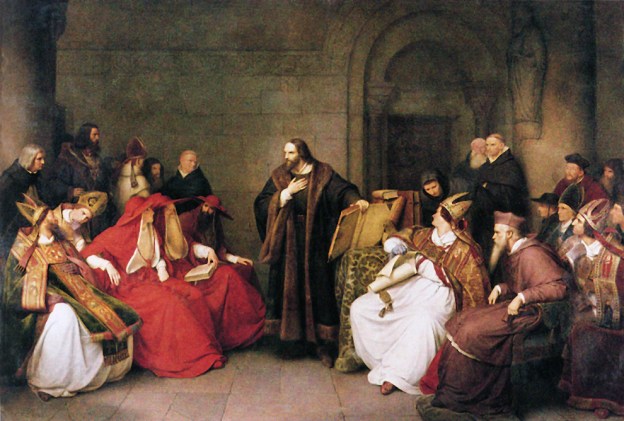
July 6 marks the anniversary of John Hus’ execution at the Council of Constance.

John Hus was an early reformer who opposed corruption in the clergy and called for a reexamination of several basic Christian doctrines. He is often called the Morning Star of the Reformation, since he preceded Luther by a century. One of his most famous stories involves a pun on his name, since Hus means goose in Czech. He is quoted in Foxe’s Book of Martyrs as saying at his death,“You are now going to burn a goose, but in a century you will have a swan which you can neither roast nor boil.”

Luther’s family crest included a swan, so Foxe adds,

If he were prophetic, he must have meant Martin Luther, who shone about a hundred years after.

Foxe’s book was written in the 1550s, a few years after Luther’s death. The goose is obviously Hus himself, and the swan is supposed to be Martin Luther, who nailed his 95 Theses to the church in Wittenberg in 1517, almost exactly a century after Hus was killed.

Was Hus really prophetic? Below are three other sources advanced for the tale. I think we can conclude that even if the quote in question is removed, Hus sensed that the Reformation would not be quenched.

Poggio Bracciolini?

The quote is also included in a sensational retelling of Hus’ trial and death, allegedly written by humanist scholar Poggio Bracciolini in 1415, but researchers believe this document to be inauthentic. It was first published in English in 1930 as Hus the Heretic, and even in German the earliest edition was in 1845, four centuries after Hus’ death. The account includes numerous anachronisms, and the publisher was known to invent legendary histories. (More here.) If anything, this document might tell how widely influential Foxe’s account was.

The Letters of John Hus: The Truth Will Send Others

D’Aubigne cites several prophetic precursors to the Reformation, including one from Hus.

[Hus] was … the John Baptist of the Reformation. …

Prophetic words came forth from the depth of his dungeon. He had a presentiment, that the true Reformation of the Church was at hand.

(History of the Reformation, ch. 6)

Then D’Aubigne quotes The Letters of John Hus. He does make a statement similar to the one quoted by Fox. Here is a newer translation:

At first they spread their nets of citations and excommunications for Hus [or goose], and have already caught many. But because goose is a lazy bird, domestic, not flying high, their net has begun to tear; likewise many other birds who fly high to God by their [writings] and their lives will tear their nets. …

For the truth they wanted to suppress has the property that the more they attempted to obscure it, the more it shone forth, and the more they pressed it down, although it sometimes falls, then rises the higher.

(tr. Spinka, pp. 82-83)

This quote, from 1412, is of course quite different from the one about the swan. The letter quoted does carry the basic thrust, though, which is that the Reformation was a work of God that would not be stopped. “Many other birds” shared Hus’ goal; Hus seemed to expect that he would die, but that the Reformation would live. He draws further parallels along this line:

Bishops, priests, masters, and scribes, Herod and Pilate, the citizens of Jerusalem and the community, condemned the Truth, put Him to death and buried Him in the grave. But He rose again and conquered them all. In place of one preacher, that is Himself, He gave them twelve and more. That same Truth in place of one faint-hearted goose, gave Prague many eagles and falcons [i.e., his contemporaries], who have keen sight, soar high by grace …

Here Hus implies that eagles and falcons, his contemporaries in Prague, are well equipped to continue where he left off.

Martin Luther: Hus Prophesied of Me
Luther had been compared to Hus and accused of being a Hussite. Luther’s response was “Oh! that my name were worthy to be associated with such a man.” The legendary quote about the goose and the swan was even known in Luther’s lifetime. Read his comments about it:

In God’s name and call I shall walk on the lion and the adder, and tread on the young lion and dragon with my feet. And this which has been begun during my lifetime will be completed after my death. St. John Huss prophesied of me when he wrote from his prison in Bohemia, “They will roast a goose now (for ‘Huss’ means ‘a goose’), but after a hundred years they will hear a swan sing, and him they will have to endure.” And that is the way it will be, if God wills. (Dr. Martin Luther’s Commentary on the Alleged Imperial Edict Promulgated in the Year 1531 After the Imperial Diet of the Year 1530, qtd. in Lutherʹs Works (Vol. 34, Page 103-104).

Luther says that Hus wrote this in prison, so each of the accounts of the prophetic words vary substantially. The legend of the goose and the swan may be true history, or it may have grown from Hus’ writings, which did affirm that God was changing the game, and Hus was just one piece. A master chess player may sacrifice one valuable piece to gain the upper hand in time; perhaps it is the roasted goose that gave the world the singing swan. After all, when you see the cries of the oppressed, the prayers of the faithful, and the movement of God on their behalf, you don’t have to be a prophet to know that God will finish his work.

Whoever dies for Christ conquers … I do not flinch from yielding my miserable life for God’s truth in danger or death.

(Letters of John Hus, tr. Spinka, pp. 83-84)

Author Guide: George MacDonald

This is a guide to the works of George MacDonald, including links to available PDFs on the Internet Archive. The books in each section are in chronological order.

If you want to see all of the ways to read MacDonald’s books for free, you can click here.
If you just want an alphabetical list of PDFs, you can find that here.

Fantasy

As a predecessor and an inspiration to 20th-century giants like Tolkien and Lewis, MacDonald may be considered by some as founding the modern fantasy genre. Many of these are clearly “fairy tales” from the beginning; others, like Phantastes and Lilith, experiment with genre.

The Curdie stories, The Princess and the Goblin and The Princess and Curdie, are two of MacDonald’s most popular books.

  1. Phantastes: A Fairie Romance for Men and Women (Our Review: ★★)
    “Cross Purposes”
  2. Adela Cathcart, containing “The Light Princess”, “The Shadows”, and other short stories
  3. The Portent
  4. Dealings with the Fairies, containing “The Golden Key”, “The Light Princess”, “The Shadows”, and other short stories
  5. At the Back of the North Wind
  6. The Princess and the Goblin (Our Review: ★★★★★)
  7. The Wise Woman: A Parable (also published as “The Lost Princess: A Double Story”; or as “A Double Story”)
  8. The Gifts of the Child Christ and Other Tales (republished as Stephen Archer and Other Tales)
  9. The Day Boy and the Night Girl
  10. The Princess and Curdie, a sequel to The Princess and the Goblin (Our Review: ★★★★★)
  11. The Flight of the Shadow
  12. Lilith: A Romance

Realistic fiction

MacDonald’s realistic novels, like good autobiography, centers around the developments within individual human souls. His novels usually have romantic elements, but this often takes a back seat to spiritual development. Fiction was a theological outlet for MacDonald, so the original printings include much more reflection and sermonic language; some of this is omitted in the new abridgements.

Beginners usually start with either Robert Falconer (Musician’s Quest in Michael Phillips’ edition), or There and Back (The Baron’s Apprenticeship).

I have tried to mark novels with Scotch dialogue by an asterisk.

  1. David Elginbrod* (updated as The Tutor’s First Love)
  2. Alec Forbes of Howglen* (updated as The Maiden’s Bequest)
  3. Annals of a Quiet Neighbourhood (Our Review: ★★★★★)
  4. Guild Court: A London Story (updated as The Prodigal Apprentice)
  5. Robert Falconer (updated as The Musician’s Quest) (Our Review: ★★★★★)
  6. The Seaboard Parish, a sequel to Annals of a Quiet Neighbourhood (Our Review: ★★★★★)
  7. Ranald Bannerman’s Boyhood* (updated as The Boyhood of Ranald Bannerman)
  8. Wilfrid Cumbermede*
  9. The Vicar’s Daughter, a sequel to Annals of a Quiet Neighborhood and The Seaboard Parish
  10. Gutta Percha Willie, the Working Genius* (updated as The Genius of Willie MacMichael)
  11. Malcolm(updated under the same title)
  12. St. George and St. Michael
  13. Thomas Wingfold, Curate (updated as The Curate’s Awakening) (Our Review: ★★★★★)
  14. The Marquis of Lossie* (updated as The Marquis’ Secret), the sequel of Malcolm (Our Review: ★★★★)
  15. Paul Faber, Surgeon (updated as The Lady’s Confession), a sequel to Thomas Wingfold, Curate
  16. Sir Gibbie* (updated as The Baronet’s Song) (Our Review: ★★★★★)
  17. Mary Marston (updated as A Daughter’s Devotion and The Shopkeeper’s Daughter)
  18. Warlock o’ Glenwarlock* (updated as Castle Warlock and The Laird’s Inheritance)
  19. Weighed and Wanting (updated as The Gentlewoman’s Choice) (Our Review: ★★)
  20. Donal Grant* (updated as The Shepherd’s Castle), a sequel to Sir Gibbie
  21. What’s Mine’s Mine (updated as The Highlander’s Last Song)
  22. Home Again: A Tale (updated as The Poet’s Homecoming)
  23. The Elect Lady (updated as The Landlady’s Master)
  24. A Rough Shaking (updated as The Wanderings of Clare Skymer)
  25. There and Back (updated as The Baron’s Apprenticeship), a sequel to Paul Faber, Surgeon (Our Review: ★★★★★)
  26. Heather and Snow* (updated as The Peasant Girl’s Dream) (Our Review: ★★★)
  27. Salted with Fire* (updated as The Minister’s Restoration)
  28. Far Above Rubies

Poetry

Diary of an Old Soul is MacDonald’s most popular book of poetry today. It is more reflective and generally introspective than devotional calendars used in his day like that of Keable. His popularity as a poet probably does not equal the ambition of these volumes, but a few of his short poems have great devotional merit.

  1. Within and Without: A Dramatic Poem
  2. Poems (1857)
  3. “A Hidden Life” and Other Poems
  4. “The Disciple” and Other Poems
  5. Dramatic and Miscellaneous Poems
  6. Diary of an Old Soul (Our Review: ★★★★)
  7. The Threefold Cord: Poems by Three Friends (privately printed, with Greville Matheson and John Hill MacDonald)
  8. Poems (1887)
  9. The Poetical Works of George MacDonald (2 vol.)
  10. Scotch Songs and Ballads
  11. Rampolli: Growths from a Long-planted Root

Nonfiction

While MacDonald wrote a few books of literary studies, his five books of sermons are, in my opinion, the best thing he ever wrote. Some readers find Unspoken Sermons too philosophical to read straight through, yet it is filled with profound theological insight—most of C. S. Lewis’ George MacDonald anthology was pulled from this three-volume set. The Miracles of Our Lord is MacDonald at his most biblical, expository, and accessible, and The Hope of the Gospel is pretty similar but with a .

  1. England’s Antiphon (a history of religious poetry)
  2. The Miracles of Our Lord (sermons) (Our Review: ★★★★★)
  3. The Tragedie of Hamlet, Prince of Denmarke: A Study With the Test of the Folio of 1623
  4. Unspoken Sermons (1st series, 2nd series, 3rd series) (Our Review: ★★★★★)
  5. A Cabinet of Gems (writings of Sir Phillip Sidney, comp. George MacDonald)
  6. The Hope of the Gospel (sermons) (Our Review: ★★)
  7. A Dish of Orts (expanded from Orts)
  8. George MacDonald in the Pulpit
  9. Getting to Know Jesus (edited sermons)
  10. Proving the Unseen (edited sermons) (Our Review: ★★★★)

Compilations

  1. God’s Words to His Children (sermons & sermonic novel excerpts)
  2. Works of Fancy and Imagination (multi-volume, short stories & poetry)
  3. Cheerful Words from the Writing of George MacDonald (comp. E. E. Brown)
  4. George MacDonald: An Anthology (comp. C. S. Lewis)
  5. Beautiful Thoughts from George MacDonald (comp. Elizabeth Dougall)
  6. Knowing the Heart of God (comp. Michael Phillips)
  7. Discovering the Character of God (comp. Michael Phillips)

New Biographies!

We have published two new paperbacks about pioneer missionaries!

Samuel Zwemer’s Biography

Apostle to Islam: A Biography of Samuel Zwemer by J. Christy Wilson is the authorized biography of Samuel Marinus Zwemer. J. Christy Wilson not only was a missionary in the Muslim world for 22 years, but he succeeded Zwemer as chair of Princeton’s Institute of Theology.

If you are interested in reading about pioneer missions in the Middle East, I would look no further than this book. Zwemer was connected everywhere. He started in pioneer missions in Iraq, Bahrain, and Egypt; he set up missions conferences specifically for reaching Muslims in India, China, and Indonesia; he taught theology and missions at Princeton, and wrote nearly fifty books while doing all this. No wonder Zwemer’s close colleague called him “a steam engine in breeches!”

Zwemer’s Lucknow conference in 1911 is considered a major turning point in missions to the Muslim world.

Ludwig Krapf’s Biography

The Life of Ludwig Krapf: The Missionary Explorer of East Africa by Paul E. Kretzmann

(Johann) Ludwig Krapf was trained for missions in Basel, Switerland. He was first-class linguist, studying Semitic languages like Hebrew, Arabic, and Ethiopic in addition to European languages. When he went to East Africa in 1827, he found these skills to be in no small demand. He published research, dictionaries, and Bible portions in no less than seven East African languages with his colleagues, including a Bible translation in Swahili. Although he tragically suffered the loss of his family on the mission field, he did not lose his indomitable and courageous spirit. It was then that he famously wrote that, since the church conquers over the graves of its workers, then the evangelization of Africa was at hand.

Paul E. Kretzmann, author of the Popular Commentary of the Bible, honed this biography from hundreds of pages of Krapf’s journals and his past biographers to create an accessible and page-turning story with a broad appeal.

Review: Dr. Grenfell’s Parish

Rating: ★★★

Who: Sir Wilfred Grenfell was an Oxford-trained physician who founded a medical mission to help the deep-sea fishermen of Newfoundland and Labrador. He established hospitals and rural medical stations, later gaining international status because of his pioneer work. He wrote many books about his work, and was knighted in 1927.

The author, Norman Duncan, was a famed novelist. Most of his books involve pioneer preachers in Canada and the northern United States.

When: Grenfell was active in his mission from 1892 to 1936. This pamphlet was published in 1905.

Where: Newfoundland and Labrador, the frigid northeastern coast of Canada.

Overview: Norman Duncan gives a brief but useful overlook of the setting of Wilfred Grenfell’s famous pioneer medical mission. Duncan is a novelist and writes with all the flare of a novelist of the period. He describes the danger and abject poverty of the fishermen of eastern Canada, as well as their spunk, optimism, and hardihood. Duncan peppers these pages with many strange and hilarious anecdotes of the place.

Meat: Grenfell’s work was innovative, charitable, and fraught with danger. (For danger, see Adrift on a Ice-pan.) He met the medical needs of many thousands of fishermen and their families, navigating treacherous waters in the summer—without radar or GPS of course—and reaching remote villages by dogsled in the winter. Duncan points out that his work was neither ignorant of his patients’ souls, nor neglectful of their bodies. Grenfell is a great example of medical work and evangelical work done at the same time and for the same purpose: to do the will of the Father in whatever we put our hands to. As the Salvation Army motto says, “with heart to God and hand to man.”

Bones: Readers seeking a missionary biography will have to look further, since this little book doesn’t tell much about Grenfell himself. It only gives a brief look at who he is and what he does, focusing rather on the scene of his work. Nevertheless, it is a fascinating introduction to Grenfell’s work, which is no longer well known.

(For further reference, Grenfell published an autobiography (A Labrador Doctor) in 1919, with the help of his wife Anne. Genevieve Fox also published a biography (Sir Wilfred Grenfell) after his passing.)

Quotes: “He is of that type, then extraordinary but now familiar, which finds no delight where there is no difficulty.” (ch. 5)

“In the spring of 1892 he set sail from Great Yarmouth Harbour for Labrador in a ninety-ton schooner. Since then, in the face of hardship, peril, and prejudice, he has, with a light heart and strong purpose, healed the sick, preached the Word, clothed the naked, fed the starving, given shelter to them that had no roof, championed the wronged—in all, devotedly fought evil, poverty, oppression, and disease; for he is bitterly intolerant of those things. And—’It’s been jolly good fun!’ says he.” (ch. 5)

Related: Vikings of Today, The Harvest of the Sea, A Labrador Doctor: The Autobiography of Wilfred Thomason Grenfell, Forty Years for Labrador, The Romance of Labrador

Herbert Lockyer

A Bibliography of Herbert Lockyer, Sr. (A-Z)

Herbert Lockyer was an astoundingly prolific writer and a thorough student of the Bible. A few years ago I stumbled on two Herbert Lockyer pamphlets while digging through the top shelf of an antique store. After I made both available for Kindle, I began to discover how many pamphlets and sermon collections Herbert Lockyer has to his name. The list turns out to be well over a hundred!

I’ve republished eight full-length books of his writings, listed below. My favorite works by him are in this collection of sermons, which is exclusively published by Pioneer Library.

The Christ of Christmas
The Gospel in the Pentateuch
A Lump of Clay & Other Sermons (exclusively from Pioneer Library)
Roses in December and Other Sermons
Sorrows and Stars 
The Swan Song of Paul: Studies in Second Timothy
When God Died 
When Revival Comes (previously titled The Mulberry Trees)

Keep scrolling to see the full list of his publications.

Continue reading

Review: Heroic Bishop (Arab World Pioneers Book 4)

Rating: ★★★★

Who: Thomas Valpy French, missionary bishop in Lahore (present-day Pakistan). He lived a long life and pioneered in a wide region in ministerial education and preaching.

Eugene Stock, a member of the (Anglican) Church Missionary Society who wrote many volumes of missions history, narrates the story.

Overview: Bishop French pioneered the Anglican bishopric of Lahore in present-day Pakistan. He helped establish a cathedral and a theological school there, in which he taught in several languages. Amazingly, in his eighties, French chose to pave a way to Oman, where he interacted with James Cantine and Samuel Zwemer. He died trying to secure passage into the interior of Arabia, which today we know as Saudi Arabia. Stock’s retelling of French’s life story is concise and inspirational.

Meat: Missionary biographies almost always impress us with the uniqueness of God’s calling and preparation in the individual life. What’s impressive about Bishop French’s life is his evangelistic zeal and his pioneer passion.

Bones: The author leaves the reader to wonder at French’s linguistic prowess—however, Zwemer points out in his own autobiography, that French’s literary Arabic was very difficult for native Arabs to understand. Christian biographies of the period (the early 20th century) tend to be brief and overwhelmingly positive, skimming over any details that might put a damper on the theme.

Meet the Moravians

Two Moravians didn’t volunteer to be slaves for the Gospel—three did. But none of them actually became slaves.

You may have heard a story passed on in many sermons about two Moravians. A former slave comes to the Moravians and tells them that his people are longing to hear the Gospel—but no one has access to them except for slaves. “Fine,” respond the undaunted Moravians. “We will sell ourselves into slavery.”

Then we fade into a shot of the two Moravians on the deck of a slave barge, headed to the West Indies, shouting at their weeping families, “May the Lamb that was slain receive the reward of his suffering!” And that is the last that their flesh and blood ever heard from them.

——

This story has taken on legendary proportions in the modern evangelical church, probably because of Paris Reidhead’s erstwhile viral sermon, “Ten Shekels and a Shirt,” and its reincarnation as the “Revival Hymn.”⁠1 But of the two scenes that pass before your mind’s eye, only one of them is true.

Fortunately for the two Moravians, the second scene is either somewhat mythical, or it is someone else’s story. The two Moravians did go to the Caribbean island of St. Thomas as missionaries, and they did preach the gospel to many slaves, but they did not become slaves themselves. Here it is worthwhile to unpack the full story of these remarkable men. I think you will agree with me that the truth of this story is just as inspiring as the legend—or more so.

Revival

The story starts with a widespread revival in the Moravian community, dated to August 13, 1727.⁠⁠2 There was a great stirring among the immigrants who had sought asylum in Count Zinzendorf’s estate, and many spoke about the claims of Christ in unknown lands.

According to Hutton’s account, many Moravians were longing to spread the Gospel abroad during the years that followed, but without any precedent, they were unsure how to move forward. On February 11, 1728, several of them made a covenant that they would go overseas once the way forward was made clear. No Protestant church was sending its own missionaries at that time, although the Danish government had supported a few in its colonies.⁠⁠3

In 1731, that changed. Antony Ulrich, a former slave from the Danish colony of St. Thomas, visited Copenhagen. He told the Danish king that the residents of the island and its slaves were primed to respond to the Gospel. He especially pleaded on behalf of his family members.

On July 24, 1731, Count Zinzendorf shared Antony’s story with his Moravian brothers. The shocking Macedonian call was passed on from ear to ear among the Moravians. A few were quietly contemplating the possibility of going to St. Thomas, but no one spoke up publicly or immediately.

Volunteers

In time, Johann Leonard Dober brought the matter up with his friend, Tobias Leupold, and they wrote a letter to Zinzendorf, declaring their intent to go. Zinzendorf shared the news of the letter with the congregation, but did not disclose their names.

Antony Ulrich, the Caribbean freedman, was still in Europe, and he followed up with Zinzendorf around this time (in present-day Germany). He spoke to the Moravians in Dutch. When Zinzendorf asked Ulrich about sending two men right away, Ulrich—mistakenly—told him that they could only come as slaves.

Both Leonard Dober and Tobias Leupold repeated without hesitation their willingness to go to St. Thomas, even as slaves. Dober wrote the congregation as he had earlier written their leader. It was a heroic declaration of sacrifice that shocked and stirred the Moravian settlement, and inspired many others to consider a commitment to preach abroad. In the end, though, such a sacrifice of freedom was both inadmissible and unnecessary.

Changed Plans

Eventually, the church decided that only Dober should go.⁠⁠4 Dober then chose another Moravian named David Nitschman to accompany him. Just like Tobias Leupold, whom he replaced, Nitschman fully expected to become a slave for the Gospel. Thus, at that point, three men had publicly and enthusiastically declared that they would be enslaved in exchange for the opportunity to preach to the unreachable.

Hutton describes the two men, waiting outside Zinzendorf’s house in the pre-dawn hours on August 21st, 1732. The Count spent the night in prayer, and then he drove them part of the way to Copenhagen. They received a prayer of blessing, and departed on foot to Denmark to secure their passage to the Caribbean.

They had a few belongings and very little money. Although the idea may have been naive, both of them—Dober and Nitschman—fully intended to sell themselves into slavery.

In the end, however, the Danish king deemed this impossible. Dober and Tobias met with Von Plesz,  the chamberlain of King Frederick VI. Here is the dialogue given in Hutton’s History of the Moravian Church:

Von Plesz, the king’s chamberlain, asked them how they would live.

“We shall work,” replied Nitschman, “as slaves among the slaves.”

“But,” said Von Plesz, “that is impossible. It will not be allowed. No white man ever works as a slave.”

“Very well,” replied Nitschman, “I am a carpenter, and will ply my trade.”

“But what will the potter do?”

“He will help me in my work.”

“If you go on like that,” exclaimed the Chamberlain, “you will stand your ground the wide world over.”⁠⁠5

Twenty-five years earlier, in 1706, King Frederick IV of Denmark had sent the first Protestant missionaries to his colonies. But Dober and Nitschman went without royal support. They were not even offered passage by the Danes.

The Rest of the Story

The ‘tall tale’ of two Moravians says that they never saw their families again.  In fact, Leonard Dober only stayed for about two years, until he was called to Herrnhut to take office as General Elder of the church there. Amazingly, Tobias Leupold—who had been turned down as his companion—broke the news to Dober in person in June 1734.⁠⁠6 This was not the end of the mission, however. The Moravians would send 18 more missionaries to those islands in the next two years.

Dober arrived in Europe February 5th, 1735 and held the office of General Elder for six years, travelling often to Holland and England during the remainder of his life. He spent the last few months of his life in Herrnhut.

David Nitschman only went to St. Thomas as an assistant to Dober in his travels, and so he left St. Thomas after just four months.⁠⁠7 Nitschman later took passage to Georgia in 1736, where he met John Wesley, and spent the later years of his life in the Moravian colony at Bethlehem, Pennsylvania.

Forerunners in Protestant Missions

Today, Moravians are little known in America; we tout them as a missionary powerhouse, but that’s where the story ends—at least at missions conferences. But in the 18th century, many Europeans viewed the Moravians as a cult, an uneducated church for spiritual outcasts and fanatics.

They had strange and unique customs, some gleaned from Zinzendorf’s leadership. The original settlement had a rote discipleship system which would sound today like a drug rehab program. They were passionate, committed, communal, innovative, and evangelistic.

When John and Charles Wesley sailed to Georgia with twenty-six Moravian shipmates, they were greatly impressed by their no-nonsense attitudes and the way they returned blessing for insult. John Wesley feared for his life during day after day of violent Atlantic storms, but he wrote in his journal of the Moravians:

“In the midst of the psalm wherewith their service began, the sea broke over, split the main-sail in pieces. … A terrible screaming began among the English. The Germans calmly sang on. I asked one of them afterwards, ‘Was you not afraid?’

He answered, ‘I thank God, no.’

I asked, ‘But were not your women and children afraid?’

He replied mildly, ‘No; our women and children are not afraid to die.'”⁠8

The Moravians’ historian takes great pride in the fact that many English Moravians preceded William Carey to the mission field. When they left for St. Thomas, Dober and Nitschman preceded William Carey by sixty years. There is no doubt that they were the first Protestant church, as far as we know, to send missionaries with no worldly or political ties.

Careers

Why, then, does the modern legend transform Nitschman and Dober into slaves? It betrays a deep confusion in modern American missiology. Maybe deep down, we believe that going overseas is pointless unless the sacrifices are tangible, irreversible, and impressive.

But it was not their romantic sacrifice that gave them access to the unreached—it was their flexibility. They did not hang on to some heroic vision of missionary life, but showed that they would undergo any hardship—even pursuing a secular vocation!

“For over one hundred years no missionary in the West Indies received from the Moravian Church one penny of salary for his services. Each man, during all the period, had first to earn his own living.”⁠9

Maybe we should also think about where the legend ends: “They went overseas.” But that is where the preface ends, and we reach page one. Leonard Dober and David Nitschman, in fact, preached the gospel to numerous slaves. They worked hard, maintained careers, baptized disciples, and preached the Gospel in the Caribbean. And their impact outlasted them.

Results

An important point to this story is that these two were not just two among a centuries-long stream of missionaries out of Herrnhut. They were the first. Immediately inspired by their commitment, a trio of Moravians joined Hans Egede in his apostolic work in Greenland.⁠⁠10

Many of the workers that followed our wayfaring pair to the Caribbean died of tropical diseases. After they left, 18 Moravian missionaries began work in St. Croix, and within two years, half of them had died. In fact, Moravian missionaries had to take their own headstone across the Atlantic with them, because the Caribbean islands couldn’t supply them with stones.

By the time Leonard Dober died, there were more than 5,000 former slaves in the Moravian congregations of the West Indies.⁠11 The Moravian Brethren still have disciples in the Caribbean today, and it started with those two young men volunteering.

Takeaways

There are a few things that stick out about this story.

First, they didn’t sell themselves into slavery; they did something much less heroic—they plied their trade. No one wants to share a story of two volunteer missionaries saying: we will do anything to reach people, even manual labor.

Second, volunteering was not enough. After they declared their intent to go to the mission field, they had to find a way to support their work. They had to be sent. The church decided one of them shouldn’t go. When they got there, real life had to happen. Willingness was only one ingredient.

Third, the story didn’t end when their ship weighed anchor from Denmark; then their work had only begun. They only contributed to the work for a couple of years, but they paved the way for the Moravian missionaries that followed them—both in the West Indies, and globally.

In the end, the mythical version says more about our generation than theirs. We would not pass on the story if it did not have a ring of romance to it. The legendary retelling certainly appeals to our heartstrings. But the heroes this generation needs are not going to be those one or two who give it all, forsake their families, and cross the seas to become slaves. We need an army of workers willing to scrap their way, by any means, to the unreached and the inconvenient lost, whether or not they have to use a university degree to do so.

Share the true story and help restore our generation’s understanding of missions. As A. W. Tozer said, you don’t become a missionary by crossing the sea; you become a missionary by seeing the cross.


1 The audio of Reidhead’s famous sermon is available here.

2 You can read about this revival, for example, in John Greenfield’s book, Power from on High, or The History of the Moravians by J. E. Hutton.

3 See, for example:

Helen H. Holcomb, Men of Might in India Missions. 1901.

J. Ferd. Fenger. History of the Tranquebar Mission. 1842. Translated from the Danish in 1863.

Jesse Page. Amid Greenland Snows: The Early History of Arctic Missions. 1904.

4 Remarkably, this decision was made using a system of casting lots for Scriptures, a practice that the Moravian Brethren have since given up, for obvious reasons.

5 J. E. Hutton. History of the Moravian Church. Book II, Chapter VI. “The Foreign Missions and Their Influence.”

The story is also told by J. E. Hutton in his History of Moravian Missions. 1922.

6 J. E. Hutton. A History of Moravian Missions. p. 37-38. 1922.

7 “Memoir of Leonard Dober.” Periodical Accounts Relating to the Missions of the Church of the United Brethren Established Among the Heathen, vol. 12. p. 241-246.

8 Richard Watson. The Life of John Wesley, p. 43. 1857.

9 J. E. Hutton. A History of Moravian Missions. p. 38-39. 1922.

10 Jesse Page. Amid Greenland Snows: The Early History of Arctic Missions. Ch. 6.

11 “Memoir of Leonard Dober.” Periodical Accounts Relating to the Missions of the Church of the United Brethren Established Among the Heathen, vol. 12. p. 241-246.